
What Happens If You Don’t Recalibrate ADAS? The Hidden Risks of Skipping Safety
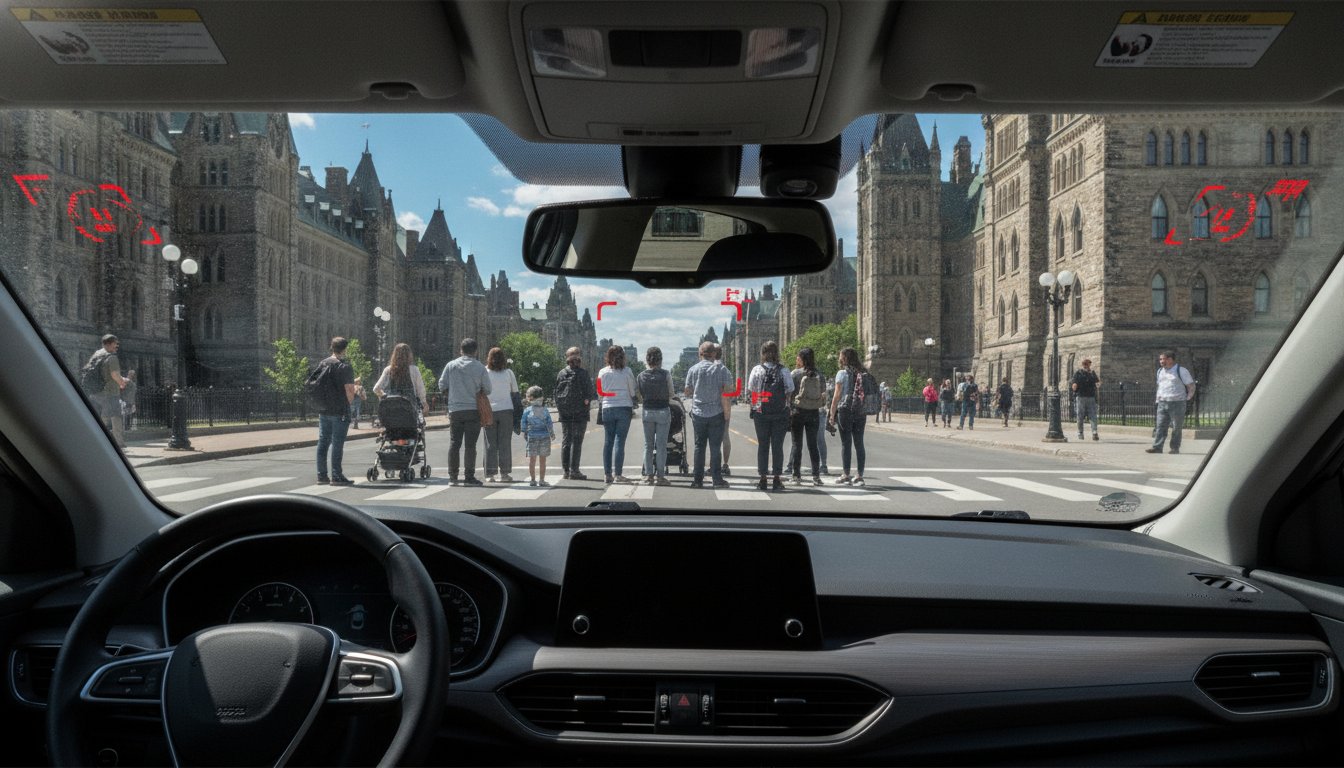
If your car’s safety sensors are off by just a few millimetres, could your emergency braking system actually cause an accident instead of preventing one? It’s completely natural to feel a bit of sticker shock when a windshield replacement comes with an added charge for camera recalibration. You might even wonder what happens if you don’t recalibrate ADAS and whether your vehicle really needs it to stay on the road.
We understand that dealing with modern vehicle technology can feel like a burden, especially when you’re already managing insurance claims in Ontario or Quebec. However, neglecting this alignment isn’t just a technical oversight; it’s a significant safety risk that can lead to system malfunctions and legal complications. This article reveals the critical safety, financial, and legal consequences of skipping recalibration. You’ll discover exactly why this process is non-negotiable for your peace of mind and how our Ottawa-based team simplifies the entire experience for you. We will help you realize the importance of precision in keeping your family safe on the road.
Key Takeaways
- Learn why the windshield is the critical mounting point for your vehicle’s safety “brain” and how even minor glass repairs impact sensor accuracy.
- Understand exactly what happens if you don’t recalibrate ADAS, including the risk of delayed reaction times and the dangerous absence of dashboard warning lights.
- Discover how a tiny one-degree error in camera alignment can lead to major safety failures when you need your emergency braking most.
- Identify the common maintenance tasks, such as suspension work or wheel alignments, that require a mandatory system reset to maintain factory standards.
- Gain confidence in choosing local Ottawa specialists who manage both the technical recalibration and the complex insurance paperwork for you.
Understanding the Link Between Your Windshield and ADAS
Modern vehicles are essentially computers on wheels. At the heart of this technology are Advanced driver-assistance systems (ADAS), which act as the “brain” for your car’s safety features. These systems use a network of sensors and cameras to monitor the road constantly. While most drivers realize their car has these features, they often don’t realize that the most critical sensor, the forward-facing camera, is physically attached to the windshield glass.
Manufacturers mount this camera to the upper centre of the windshield because it provides the best vantage point. It mimics the driver’s line of sight to track lanes, vehicles, and pedestrians. Because the camera looks through the glass, the windshield isn’t just a window; it’s a high-precision optical lens. Even a tiny change in glass thickness, curvature, or the angle of the mounting bracket can distort the camera’s “vision.” This is why a windshield replacement is much more than a simple glass swap. It’s essentially major surgery for your vehicle’s safety network.
Common ADAS Features Relying on Your Windshield
Several life-saving features depend entirely on a clear, correctly aligned view through your front glass. Drivers often ask what happens if you don’t recalibrate ADAS, and the answer starts with how these specific features function:
- Lane Departure Warning (LDW) and Lane Keep Assist: These systems “see” road markings. If the camera is tilted by even a fraction of a degree, the car might think you’re drifting when you’re perfectly centred in the lane.
- Automatic Emergency Braking (AEB): This relies on accurate depth perception. If the camera’s alignment is off, the system might miscalculate the distance to the car ahead, leading to a late or unnecessary reaction.
- Adaptive Cruise Control: This uses visual data to maintain a safe gap. Misalignment can cause jerky braking or unsafe following distances on busy highways.
- Pedestrian Detection: Clarity and focus are vital here. The system must distinguish a person from a stationary object in milliseconds.
The Role of the Camera Bracket and Mounting
When we replace a windshield, the camera must be transferred from the old glass to the new one. This requires extreme precision. The camera sits in a specialized bracket that must be perfectly level and secure. Using professional-grade adhesive is non-negotiable because any vibration or slight shift over time will throw the sensors out of alignment. “Close enough” simply doesn’t cut it when you’re travelling at 100 km/h on the 417. If the bracket is off by even a millimetre, the projected “view” of the road could be off by several metres in the distance. This is exactly what happens if you don’t recalibrate ADAS after a replacement; the car’s brain is working with incorrect visual data while you assume everything is functional.
The Dangerous Reality: What Happens When You Skip Recalibration
Skipping recalibration isn’t just a technical oversight; it’s a decision that compromises the very features you rely on to stay safe. If you’re wondering what happens if you don’t recalibrate ADAS, the most immediate risk is a total loss of trust in your vehicle’s safety responses. When a camera is misaligned by even a fraction of a millimetre, the car’s “vision” is distorted. This leads to unpredictable steering and braking that can turn a helpful assistant into a dangerous hazard on the road.
The “Invisible Error” Phenomenon
Many drivers assume their car will tell them if something is wrong. In reality, modern vehicle computers are designed to be resilient. They often attempt to “fill in the gaps” or compensate for a slightly tilted image. This creates a false sense of security because your dashboard might not show a single warning light. However, when a split-second decision is required, the computer may realize it can’t reconcile the conflicting data and simply shut down the safety system entirely. This “invisible error” means your Automatic Emergency Braking (AEB) might not engage at the exact moment you need it most. Ensuring your safety shouldn’t be a guessing game. If you’ve had a recent glass repair, a quick check with the professionals at Auto Glass Ottawa can confirm your sensors are actually doing their job.
Impact on Collision Avoidance Systems
Miscalibration creates dangerous blind spots in your vehicle’s software logic. If your forward-facing camera is tilted downward by just one degree, it might interpret a distant car as being much closer than it is. This often results in “phantom braking,” where your car suddenly slams the brakes while you’re cruising on the 417 or 416. Conversely, a camera tilted upward might not “see” a stopped vehicle until it’s far too late to prevent a crash. Many drivers don’t realize what happens if you don’t recalibrate ADAS until they experience a near-miss or a sudden, unexplained steering pull during a lane change.
The precision required for these systems is so significant that it has sparked a federal bill for ADAS calibration to standardize how these repairs are handled. Without a professional reset, your Lane Keep Assist could pull your steering wheel toward oncoming traffic because it misinterprets where the lane markings actually sit. In the busy streets of Ottawa, these small margins for error can lead to preventable accidents and complex insurance disputes that are easily avoided with a certified calibration.
Small Margins, Large Errors: The Physics of ADAS Misalignment
Safety in modern vehicles is a game of millimetres. When we discuss ADAS, we are dealing with high-precision optics that rely on absolute angular accuracy. If a camera is tilted slightly during a windshield replacement, it creates what technicians call an “angular error.” While a one-degree shift might look invisible to the naked eye when you’re sitting in the driver’s seat, the physics of the road tell a far more dangerous story. Truly understanding what happens if you don’t recalibrate ADAS requires looking at how these tiny discrepancies project over long distances.
The Geometry of a 1-Degree Error
Precision is everything when your vehicle’s computer is making split-second decisions. Consider this: “A camera misaligned by just one degree can misjudge the position of a car 40 metres ahead by several feet.” This isn’t just a theoretical calculation; it has real-world consequences for your safety. Your vehicle essentially perceives the road through a specific “cone of vision.” If that cone is tilted even slightly, the software might interpret a car in the adjacent lane as being directly in your path.
At highway speeds of 100 km/h or more, these technical errors are amplified. A system that is off by a few feet might fail to recognize a stalled vehicle on the shoulder as a hazard. Alternatively, it may trigger an emergency stop because it misidentifies an overhead sign as an obstacle. When you realize that these systems are designed to supplement human reaction times, you can see how a small physical misalignment turns a safety feature into a source of unpredictability.
Static vs. Dynamic Recalibration Explained
To correct these physical errors, technicians use two primary methods to ensure your car’s “eyes” are correctly aligned. Each process requires specialized equipment that you won’t find in a standard tool kit.
- Static Recalibration: This takes place in a highly controlled shop environment. We use specialized targets, lasers, and level floors to perform an “eye exam” for your car while it is stationary. It’s the only way to ensure the camera is perfectly centred according to the manufacturer’s original specifications.
- Dynamic Recalibration: This process involves driving the vehicle on Ottawa roads at specific speeds. The car’s computer monitors stationary objects like road markings and signs to organize its internal spatial map.
Some vehicles require only one of these methods, but many newer models need both to be fully synchronized. Without professional-grade diagnostic tools, it is impossible to achieve the millimetre-perfect accuracy needed for these systems to function. This is why skipping this step after a glass repair leaves your vehicle’s safety features in a compromised state.
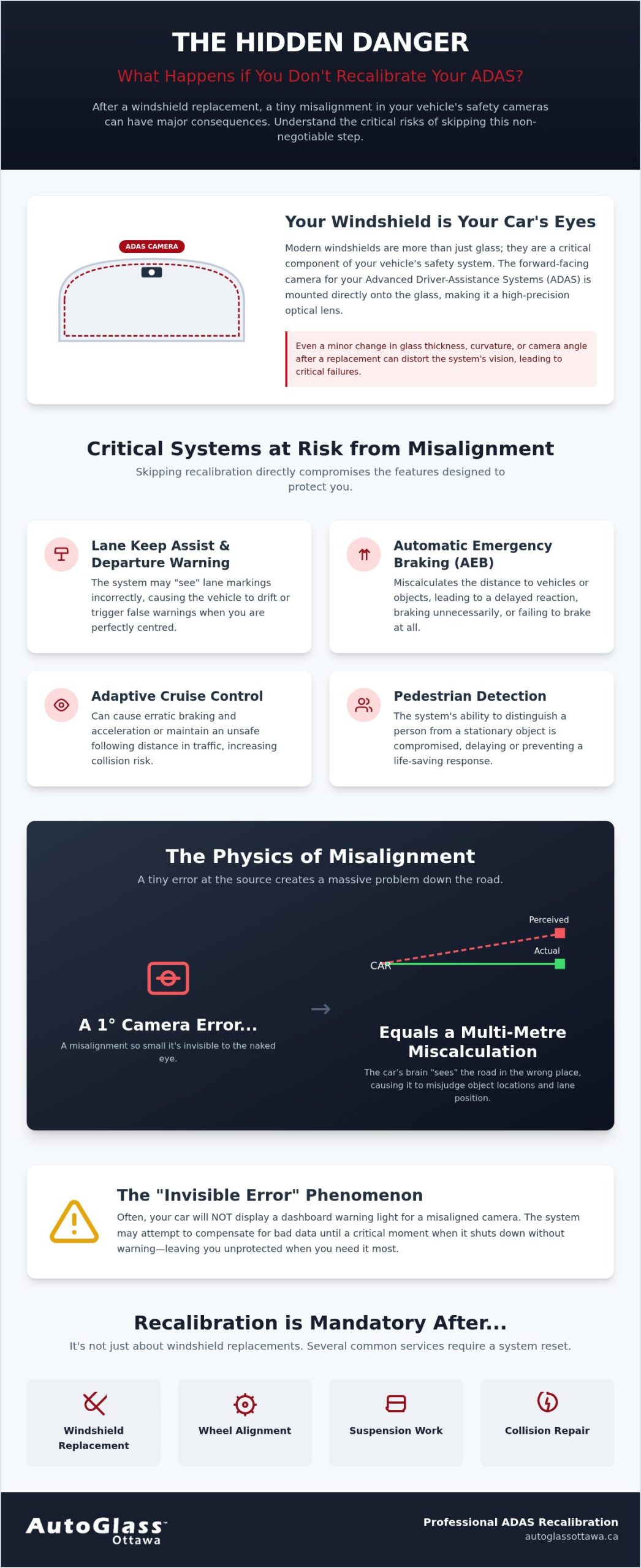
Beyond Windshield Replacement: When Else is Recalibration Mandatory?
Most drivers associate sensor resets exclusively with glass work, but the reality is more complex. Your safety system’s accuracy depends on the vehicle maintaining a specific “stance” relative to the road. If that stance changes due to mechanical work or road damage, the camera’s perspective shifts. Understanding what happens if you don’t recalibrate ADAS in these scenarios is vital because the system may begin to provide data based on an outdated physical profile of the car. Even if your windshield is perfectly intact, changes to the chassis or wheels can leave your safety features blind to the true conditions of the road.
Suspension and Alignment Triggers
When you perform a wheel alignment or suspension repair, you are altering the vehicle’s pitch and thrust angle. The camera, mounted high on the windshield, uses the road’s horizon as a primary reference point. If a new set of springs, a levelling kit, or even a change in tire size raises the front of the vehicle by even a centimetre, the camera is now looking significantly higher than it was programmed to. This misalignment causes the software to miscalculate the distance to objects ahead. A standard wheel alignment should always trigger an ADAS health check to ensure the sensors are still looking exactly where they should and are fully organized according to factory specifications.
Local Environmental Factors in the National Capital Region
Living in the Ottawa and Gatineau area presents unique challenges for sensitive automotive electronics. The “Ottawa Factor” includes some of the most severe potholes in the province. A significant curb strike or a deep pothole on a road like Carling Avenue can jar the camera mounting bracket just enough to throw off its calibration. Even if the windshield didn’t break during a minor collision, the force of the impact can be enough to shift the delicate sensors housed in your bumpers or behind the glass.
Extreme temperature fluctuations, common in our region, can also cause materials to expand and contract. This stress can weaken the adhesives used for sensor mounts over time. Additionally, the heavy use of road salt and winter grime can obstruct external LiDAR and Radar sensors. If you’ve experienced a significant undercarriage impact or noticed your safety warnings behaving erratically after a harsh winter, a professional inspection is essential. To ensure your vehicle remains a safe sanctuary for your family, book an ADAS inspection with Auto Glass Ottawa today. We specialize in making sure your car’s “eyes” are perfectly aligned for local driving conditions.
Professional ADAS Recalibration in Ottawa: Your Path to Safety
Choosing the right team to handle your vehicle’s safety technology shouldn’t be a stressful decision. At Auto Glass Ottawa, we treat every sensor reset as a critical safety procedure rather than just a technical add-on. If you’re worried about what happens if you don’t recalibrate ADAS, our goal is to remove that anxiety by providing a seamless, professional solution right at your doorstep. Our free mobile service means you don’t have to spend your day waiting in a shop. We bring our certified expertise to your home or office anywhere in Ottawa or Gatineau, ensuring your schedule remains uninterrupted while your vehicle gets the care it requires.
Navigating Insurance and Deductibles
Many drivers hesitate to book a recalibration because they worry about high service costs. In reality, skipping this step is a false economy. Most comprehensive insurance policies in Ontario and Quebec cover ADAS recalibration as a mandatory safety requirement following a windshield replacement. We specialize in insurance claim assistance, which means we take the administrative heavy lifting off your shoulders. We work directly with your provider to ensure the calibration is documented and billed correctly. Since these systems are essential for the vehicle’s safety integrity, insurers recognize them as a necessary part of the repair. You shouldn’t have to choose between your budget and your family’s safety on the road.
The Auto Glass Ottawa Difference
With more than 15 years of local experience, we’ve seen the evolution of vehicle technology firsthand. We don’t just swap glass; we ensure the entire safety ecosystem of your car is functioning perfectly. Our technicians are specifically certified for ADAS procedures, using professional-grade tools to meet strict manufacturer standards. We also provide a lifetime warranty on our workmanship, so you can drive with confidence knowing the job was done right the first time. We take pride in being a trusted local authority that prioritizes precision and punctuality for every customer. Don’t leave your safety to chance or settle for a “close enough” alignment. Contact us today for a free mobile quote and ensure your ADAS is safe.
Prioritize Your Peace of Mind on the Road
Neglecting recalibration turns your vehicle’s safety features into unpredictable liabilities. You now understand that even a tiny angular error can cause your emergency braking or lane keep assist to fail when you need them most. Realizing what happens if you don’t recalibrate ADAS is the first step toward protecting your family and your vehicle’s integrity. Whether you’ve recently replaced a windshield or survived a harsh Ottawa winter, professional alignment is the only way to ensure your car’s “eyes” are correctly organized.
Our team brings over 15 years of local expertise directly to your driveway. We handle the technical precision and the insurance paperwork so you don’t have to. With our 100% free mobile service across Ottawa and Gatineau and a lifetime warranty on all workmanship, safety is a seamless experience. Take the final step in your vehicle’s care and drive with complete confidence.
Get Your Free Mobile Quote for Windshield Replacement & ADAS Recalibration
Frequently Asked Questions
Is it illegal to drive without ADAS recalibration in Ontario?
It is not strictly illegal to drive without recalibration in Ontario, but you may be held liable for safety violations. If an accident occurs because your safety features failed to engage, you may face legal consequences or insurance complications. Maintaining your vehicle to manufacturer specifications is essential for roadworthiness. Skipping this step often results in a car that doesn’t meet the safety standards required for legal operation on public roads.
Will my insurance cover the cost of ADAS recalibration?
Yes, most insurance providers in Ontario and Quebec cover ADAS recalibration as part of a comprehensive glass claim. Since the camera alignment is a mandatory safety requirement for modern windshields, it’s typically treated as a necessary portion of the repair. We assist with the paperwork to ensure the process is seamless for you. You generally only pay your deductible, though some policies offer glass coverage with a zero-dollar deductible.
How long does a typical ADAS recalibration take?
A professional recalibration usually takes between 60 and 90 minutes. The exact time depends on whether your vehicle requires a static calibration in a controlled environment or a dynamic calibration performed on local roads. Some high-tech models require both processes to be fully synchronized. We prioritize efficiency to get you back on the road quickly while ensuring every sensor is perfectly aligned to meet the strict manufacturer safety standards.
Can I recalibrate my car’s camera system myself?
No, you cannot perform this task yourself because it requires specialized diagnostic software and precision targets. Recalibration involves millimetre-perfect physical alignment and a digital handshake with your car’s computer. Without professional-grade equipment, it’s impossible to verify if the sensors are seeing the road correctly. Attempting a DIY fix is dangerous and is exactly what happens if you don’t recalibrate ADAS properly; the system may provide false data during a crisis.
What happens if I ignore the ADAS warning light on my dash?
Ignoring the warning light means you’re driving with a compromised safety system. Your car may disable features like Automatic Emergency Braking or Lane Keep Assist entirely to prevent an accidental triggering. In other cases, the system might stay active but behave unpredictably, such as braking for non-existent obstacles. This creates a significant risk for everyone on the road. A dashboard light is a clear signal that your vehicle’s brain is no longer organized correctly.
Do all cars need recalibration after a windshield replacement?
Can a mobile technician perform ADAS recalibration at my home in Ottawa?
Yes, our certified technicians provide a 100% free mobile service that includes ADAS recalibration at your location. We bring the necessary diagnostic tools and targets to your home or office in Ottawa or Gatineau. This eliminates the need for you to visit a dealership or wait in a shop. We ensure your safety systems are fully functional and backed by our lifetime warranty on workmanship, providing convenience without compromising on technical precision.
What is the difference between a “soft” and “hard” ADAS reset?
A soft reset usually involves clearing minor electronic error codes through the vehicle’s diagnostic port, which doesn’t always fix physical misalignments. A hard reset, or a full recalibration, is a comprehensive process that physically aligns the camera and recalibrates the software to the new glass. Understanding what happens if you don’t recalibrate ADAS with a full hard reset is crucial; a simple code clear won’t fix a camera that is physically tilted.