
Repairable Windshield Chips: A Visual Guide for Ottawa Drivers
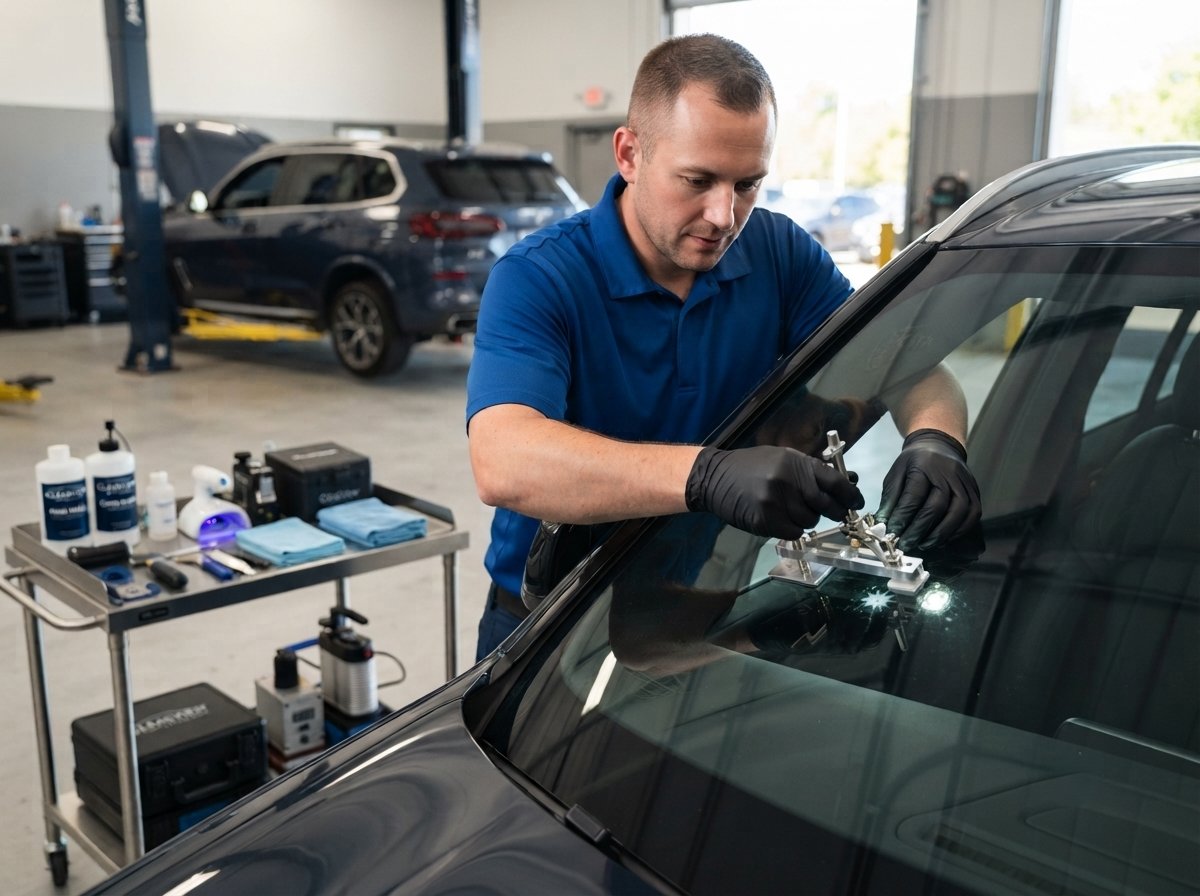
You are cruising down the Queensway when a tiny pebble pings against your glass, leaving a mark no bigger than a pea. It seems harmless in the moment, but for Ottawa drivers, that small blemish is a ticking time bomb waiting for the first -20°C night to turn it into a dashboard-spanning disaster. It is natural to feel a sense of dread when you spot fresh damage, especially if you are worried about the cost of a full replacement or whether a store-bought DIY kit will actually work. You want to protect your vehicle, but you don’t want to gamble with your safety.
The good news is that many repairable windshield chips can be professionally restored to their original strength if you act before moisture and road salt settle into the glass. This guide will help you realize exactly which types of damage can be saved and when a full replacement is your only safe option. We will break down the visual criteria for a successful fix, explain why Ottawa’s freeze-thaw cycle is your windshield’s worst enemy, and show you how insurance often covers the professional repair to keep your commute stress-free.
Key Takeaways
- Learn how to use a simple loonie-sized test to determine if you have repairable windshield chips or if the damage has compromised the glass too deeply for a fix.
- Identify the visual differences between bullseyes and star breaks to understand the immediate risk of the damage spreading across your dashboard.
- Recognize the “no-fix” zones, such as the driver’s direct line of sight and the windshield edge, where safety regulations require a full replacement.
- Discover why Ottawa’s extreme temperature fluctuations and winter road salt make it critical to seal chips before the first freeze-thaw cycle begins.
- Understand why professional vacuum-sealed resin injections provide a durable, clear finish that standard DIY kits simply cannot achieve.
Defining Repairable Windshield Chips: The 3 Golden Rules
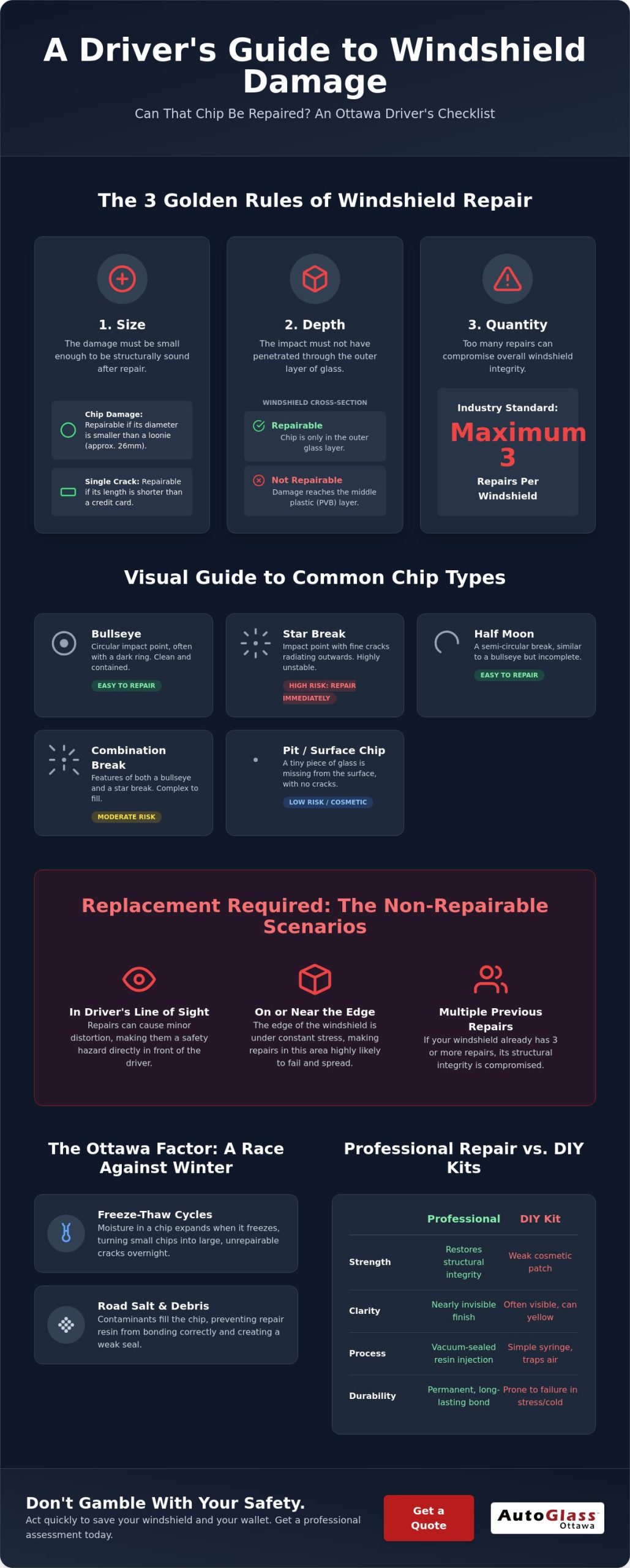
Not every stone chip requires a brand-new windshield. In many cases, a skilled technician can inject a specialized resin to restore the clarity and strength of the glass. However, for a fix to be safe and effective, the damage must meet specific criteria. We call these the three golden rules of repairable windshield chips: size, depth, and quantity. If your damage falls outside these parameters, the structural integrity of your vehicle is at risk. Acting quickly is the best way to ensure your glass remains a candidate for a professional fix.
The Loonie Rule vs. The Credit Card Rule
Most modern windshields are made of laminated safety glass, which consists of two glass layers bonded to a plastic interlayer. A chip is generally repairable if its diameter is smaller than a loonie. This Canadian coin is a perfect local reference, measuring approximately 26mm. If the impact point is larger than this, the glass has likely suffered too much stress to be stabilized by resin alone.
While surface width matters, the depth of the impact is the real deal-breaker. If the rock has punched through the outer layer and damaged the inner plastic (PVB) layer, the glass is no longer a candidate for repair. For horizontal cracks, we use the credit card rule. If the crack is shorter than a standard credit card, it can often be filled and sealed. Cracks that exceed this length are prone to spreading rapidly, especially when you hit a pothole or experience a sudden temperature change.
Why Quantity Matters for Your Safety
Your windshield provides up to 30% of your vehicle’s structural strength during a rollover. Every repair, no matter how professional, introduces a small point of tension in the glass. Industry standards generally cap repairs at three chips per windshield. Attempting a fourth or fifth repair can compromise the glass’s ability to protect you. If you have multiple points of damage, it is worth checking out our guide on when to replace vs repair your windshield to see if your car still meets safety standards.
Finally, the chip must be clean. In Ottawa, road salt and slush are constant threats. If a chip sits open for weeks, it fills with debris and salt crystals that prevent the resin from bonding properly. A “dirty” chip might look fixed on the surface, but it won’t hold up against the next temperature swing. If you can’t get to a shop immediately, place a small piece of clear tape over the chip to keep it dry and debris-free until a professional can assess it.
A Visual Guide to Common Chip Types and Their Fixability
Identifying the specific shape of your damage is the first step in determining if you have repairable windshield chips. While size is a primary factor, the geometry of the break dictates how the resin will flow and bond within the glass. Most stone chips fall into a few distinct categories that professional technicians use to gauge the success rate of a repair. Understanding these visual cues helps you manage expectations for the final result.
- Bullseye: A circular impact point with a dark outer ring. These are usually the easiest to repair cleanly.
- Star Break: A series of fine, radiating cracks that look like a starburst. These are highly unstable.
- Half-Moon: A semi-circular version of the bullseye, often caused by a rock hitting at an angle.
- Cloverleaf: A complex break where the glass has separated in multiple directions across different layers.
- Pit: A small surface crater where a tiny piece of glass is physically missing but no cracks are present.
Identifying the “Spreaders”
Star breaks are the most dangerous type of “repairable” damage you can encounter. These radiating legs act like fault lines in your glass. The constant vibration from Ottawa potholes or the heavy rumble of traffic on the 417 can trigger these legs to “leg out” across the entire windshield without warning. Because the cracks are so thin, they are highly sensitive to pressure. Star breaks require immediate professional attention to avoid a full replacement. If you wait too long, the dirt and moisture that collect in those fine lines will make a clean repair impossible.
The Bullseye Advantage
If you have a bullseye or a half-moon, you have the best chance for a nearly invisible fix. These circular breaks create a pocket that is ideal for resin injection. Following industry best practices for windshield repair, a technician can vacuum out the air and replace it with industrial-grade resin that matches the refractive index of your glass. After a professional bullseye repair, the damage is often 90% to 95% invisible to the naked eye. To protect a fresh bullseye, avoid using your windshield wipers or washer fluid, as this can force contaminants into the break.
Cloverleaf breaks and deep pits require a bit more finesse. A cloverleaf often involves multiple impact points within a small area, requiring the technician to ensure the resin reaches every “leaf” of the break. Pits are often simpler to fix but require a thicker “pit-fill” resin to smooth the surface. This prevents your wiper blades from catching on the rough edge and wearing down prematurely. If you spot any of these shapes on your glass, a quick check-in for mobile windshield repair can often save the glass before the damage evolves.
When a Chip Becomes a Replacement: The Non-Repairable Scenarios
While many repairable windshield chips can be saved with a quick resin injection, certain scenarios make a full replacement the only safe choice. The decision isn’t just about aesthetics. It’s about maintaining the structural integrity mandated by the Auto Glass Safety Council. If your damage falls into a “red zone,” attempting a repair could leave you with a compromised windshield that fails during a collision or rollover. Understanding these limits helps you prioritize your safety on the road.
The Danger of Edge Chips
The perimeter of your windshield is under significantly more tension than the centre. This area is responsible for a large portion of the glass’s structural strength, which can account for 30% to 60% of a vehicle’s structural integrity. Any chip or crack within 2 inches of the edge is usually non-repairable. These “edge chips” are notorious for spreading rapidly because of body flex and temperature changes. Additionally, the black ceramic border, known as the frit, makes it nearly impossible for a technician to see if the resin has fully penetrated the break. Statistics show that 90% of edge chips will eventually spread into a massive crack, regardless of whether a repair was attempted.
ADAS and Modern Safety Tech
Modern vehicles are smarter than ever, but they are also more sensitive. If your car features lane-keep assist, automatic emergency braking, or a heads-up display (HUD), your windshield is more than just glass. It is a lens for your Advanced Driver Assistance Systems (ADAS). A repair in front of these cameras or sensors can cause minor visual distortion. While a human eye might not notice it, a camera can miscalculate distances or fail to see lane markings. In these cases, safety standards require a full replacement followed by ADAS recalibration after windshield replacement to ensure your safety tech functions as intended.
The “Critical Viewing Area” is another non-negotiable zone. This is the space directly in the driver’s line of sight, roughly the size of a standard piece of paper. Even the best resin repair can leave a slight “scar” or blur. Under the Ontario Highway Traffic Act, any damage that obstructs or distorts the driver’s view can result in a failed safety inspection. Finally, consider contamination. If you have been driving with an open chip for weeks, it has likely collected road salt, washer fluid, or car wax. These substances act as a barrier, preventing the resin from bonding to the glass. If the damage is too contaminated to clean, the repair will likely fail, making a replacement the only reliable path forward.
The Ottawa Factor: How Temperature and Road Salt Affect Repairability
Ottawa’s climate is notoriously harsh on automotive glass. While a stone chip might stay dormant for months in a milder city, our local temperature swings act as a catalyst for rapid damage. Most repairable windshield chips fail not because of the initial impact, but because of the environmental stress that follows. If you want to save your glass, you have to understand how the National Capital Region’s weather works against you. Waiting until the weather “clears up” is often the quickest way to ensure you need a full replacement.
The freeze-thaw cycle is the primary culprit. When snow or freezing rain hits your windshield, moisture seeps into the microscopic crevices of the chip. As the temperature drops overnight, that water turns to ice and expands. This physical expansion exerts massive pressure on the surrounding glass, often forcing the chip to “blossom” into a series of radiating cracks. By the time you finish scraping your windshield in the morning, the damage has already grown beyond the loonie-sized limit for a safe repair.
Winter “Thermal Shock” and Your Glass
One of the most common ways a small chip turns into a full-blown crack is through thermal shock. Imagine it is -20°C outside and you jump into your car, immediately blasting the defroster on high to clear the frost. The rapid temperature change causes the glass to expand unevenly. The area directly above the heater vents expands while the outer edges remain frozen. This creates a violent tug-of-war within the glass layers. If you have an existing chip, it acts as a structural weak point; the glass will almost certainly snap under the tension in under five minutes of driving.
Road salt adds another layer of difficulty. Ottawa uses extensive amounts of salt and liquid brine to keep the 417 and local roads safe. These chemicals are highly corrosive and can settle deep into an open chip. Once salt and road grime contaminate the area, it becomes nearly impossible for professional resin to bond properly. If you can’t get a repair immediately, place a small piece of clear office tape over the chip. This simple trick keeps salt and washer fluid out, preserving the chip’s status as “repairable” until you can reach a technician.
Why Spring is “Crack Season” in the Valley
As the snow melts, Ottawa drivers face a new threat: the pothole. The vibrations from hitting a deep hole on Carling Avenue or the Parkway send a sharp shockwave through your vehicle’s chassis. Because the windshield is a stressed member of the car’s frame, it absorbs a significant portion of this energy. If a chip is already weakened by winter moisture, one bad bump can be the final straw that sends a crack across your entire field of vision.
This combination of moisture, salt, and vibration makes spring the busiest time for glass shops in the Ottawa Valley. If you notice your windshield crack spreading, you must act within hours to have any hope of saving the glass. Our technicians use specialized heating and moisture-evacuation equipment to stabilize the glass even in sub-zero temperatures, ensuring the resin cures correctly despite the weather. Don’t let a small stone chip survive the winter only to shatter in the spring. Contact us for mobile windshield repair to seal the damage before the next temperature drop.
Professional Resin Injection: Why Pro Fixes Beat DIY Kits
When you discover repairable windshield chips, the temptation to grab a fifteen-dollar DIY kit from a big-box store is high. These kits promise a quick, permanent fix for a fraction of the cost of a professional service. However, there is a significant gap between a cosmetic patch and a structural repair. In the Ottawa climate, where glass faces extreme stress, the quality of the resin and the method of injection determine whether your windshield remains safe or shatters during your next highway commute. A professional repair is not just about filling a hole; it is about restoring the original strength of the glass.
The primary difference lies in the materials used. Professional technicians use industrial-grade resins designed to match the specific refractive index of automotive glass. This ensures that light passes through the repair without bending, making the fix nearly invisible. These high-quality resins are also engineered to withstand the intense UV radiation of summer and the deep freezes of a Valley winter without yellowing or shrinking. In contrast, many DIY kits use low-viscosity resins that can become brittle over time, eventually failing when the glass expands or contracts. To understand exactly how these specialized materials work at a molecular level, see our detailed breakdown of windshield repair resin injection for Ottawa drivers.
The Vacuum vs. Gravity Debate
The mechanical process of a professional repair is far superior to any over-the-counter solution. DIY kits typically rely on a simple plastic plunger and the force of gravity to move resin into the break. This often traps air bubbles inside the chip. These air pockets act as tiny pressure cookers; when the air inside expands due to heat, it can force the chip to spread into a full crack. Professional tools utilize a dual-stage process. First, a high-powered vacuum pulls every molecule of air and moisture out of the damage. Then, the tool uses 20+ lbs of pressure to force the resin into every microscopic fissure. This ensures 100% penetration and a bond that is physically integrated with the glass layers.
Precision curing is the final step in a professional fix. Once the resin is injected, technicians use specialized UV lamps with specific wavelengths to trigger a chemical hardening process. This ensures the resin reaches its maximum structural strength in minutes. DIY kits often rely on natural sunlight for curing, which is inconsistent and can lead to an incomplete bond if the weather is overcast or cold. Because a professional repair is a one-time investment in your safety, it typically comes with a lifetime warranty. If the repair ever fails or the chip spreads, the value is often credited toward a replacement.
Hassle-Free Mobile Service
You don’t have to disrupt your day to get a professional result. We realize that your time is valuable, which is why Auto Glass Ottawa provides comprehensive mobile windshield repair throughout the region. Whether you are at home in Kanata or at your office downtown, a certified technician can assess your damage on-site. This professional assessment is critical; a pro can spot the subtle signs of contamination or structural weakness that a DIYer might miss. Choosing a professional fix means you are getting a solution that is validated by industry safety standards rather than a temporary cosmetic patch. Book your free mobile windshield repair in Ottawa today to ensure your glass is ready for whatever the season throws your way.
Secure Your Safety Before the Next Temperature Drop
A small stone chip is more than just a cosmetic blemish; it is a structural vulnerability that Ottawa’s harsh climate will eventually exploit. By understanding the loonie rule and recognizing the visual warning signs of a spreading crack, you can take control of your vehicle’s safety. Professional vacuum-sealed resin is the only reliable way to stabilize repairable windshield chips and prevent the cost of a full replacement. Acting now ensures that your vision remains clear and your windshield provides the protection you need during a collision.
You don’t have to navigate the stress of a damaged windshield alone. Our certified technicians bring over 15 years of experience directly to your driveway or office with 100% free mobile service across Ottawa and Gatineau. We stand behind every fix with a lifetime warranty on workmanship and leakage, giving you total peace of mind. Get a Free Quote for Mobile Windshield Repair in Ottawa today and let us handle the technical details while you stay focused on the road ahead. Don’t let a tiny chip become a major headache this winter.
Frequently Asked Questions
Can a windshield chip be repaired if it is in my line of sight?
No, safety standards typically prohibit repairs in the driver’s critical viewing area. This zone is roughly the width of a standard piece of paper directly in front of the steering wheel. Even the highest quality resin can leave a slight visual distortion or “scar” that could distract you or obscure a hazard on the road. For your safety and to pass an Ontario safety inspection, damage in this area usually requires a full replacement.
How long does a professional windshield chip repair take?
A professional repair usually takes between 20 and 30 minutes to complete from start to finish. Our technicians clean the impact point, vacuum out the air, inject the industrial resin, and cure it using specialized UV lights. Because the process is so efficient, many drivers choose our mobile service to have the work done while they are at home or in the office, avoiding any disruption to their daily schedule.
Will my insurance premium go up if I claim a windshield repair in Ontario?
In most cases, claiming a windshield repair will not increase your insurance premiums in Ontario. Glass damage is typically covered under the “comprehensive” portion of your policy rather than “collision.” Many insurance providers actually waive your deductible for repairable windshield chips because they would much rather pay for a simple fix now than a costly full replacement later. We provide insurance claim assistance to help you navigate this paperwork easily.
Is it safe to drive with a small chip in my windshield?
While your car remains drivable, it is not truly safe to ignore any glass damage. A small chip compromises the structural integrity of the windshield, which provides up to 60% of your vehicle’s structural strength during a rollover accident. Additionally, a minor blemish can turn into a dashboard-spanning crack instantly if you hit a pothole or use your defroster on a cold Ottawa morning. It is always safer to stabilize the damage immediately.
What happens if a chip is too old to be repaired?
If a chip has been left open for too long, it becomes contaminated with road salt, washer fluid, and microscopic debris. This contamination creates a barrier that prevents the professional resin from bonding correctly to the glass. If our technicians determine the damage is too “dirty” or weathered to be safely stabilized, we will recommend a replacement to ensure your vehicle remains roadworthy and safe for your family.
Can I use a DIY windshield repair kit in the winter?
Using a DIY kit during an Ottawa winter is highly discouraged because the resin requires specific temperatures to flow and cure properly. Retail kits lack the professional vacuum tools needed to remove moisture and frost from inside the chip before injection. If moisture is trapped inside when the resin hardens, it will eventually freeze and expand, causing the repair to fail and the glass to crack anyway. Professional tools are essential for cold-weather fixes. Learn more about how professional-grade windshield repair resin injection in Ottawa is specifically engineered to handle extreme cold-weather conditions.
Will the chip be completely invisible after a professional repair?
A professional fix will make repairable windshield chips nearly invisible, but a faint mark may remain. You should expect an 85% to 95% improvement in visual clarity, depending on the type of break and how quickly it was treated. The primary goal of a professional repair is to restore the structural strength of the glass and prevent the damage from spreading, while the cosmetic improvement is a secondary benefit of the high-grade resin.
Does Auto Glass Ottawa offer mobile chip repair for commercial fleets?
Yes, we provide dedicated commercial auto glass services and mobile repair for fleets of all sizes across the region. We realize that every hour a service vehicle is off the road costs your business money. Our technicians can visit your job site or depot to perform multiple repairs in one visit, ensuring your drivers stay safe and your company vehicles remain compliant with Ontario safety standards without the hassle of shop appointments.