
OEM vs Aftermarket Auto Glass Quality: Which Should You Choose?
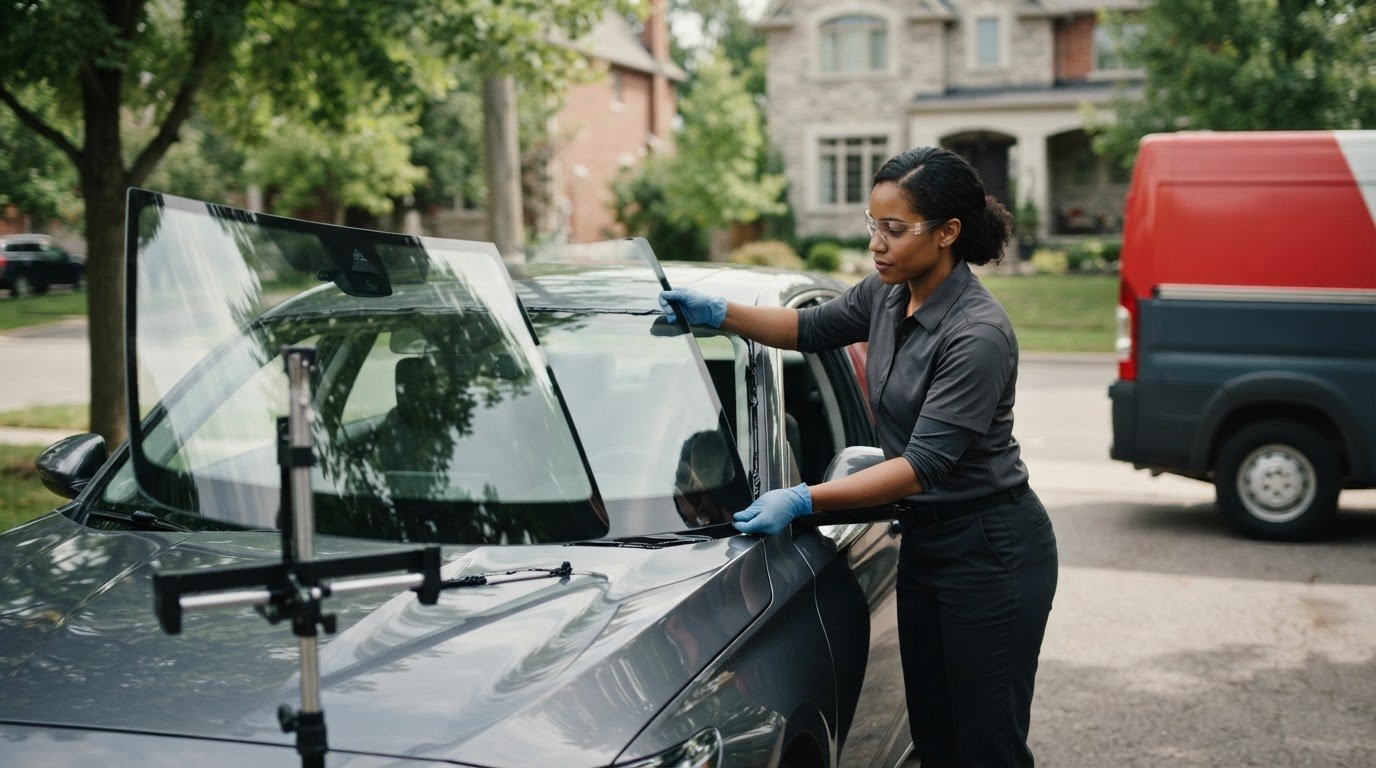
The stamp of an automaker’s logo on your windshield doesn’t automatically make your vehicle safer than a certified equivalent. When evaluating OEM vs aftermarket auto glass quality, real protection depends on strict Canadian manufacturing standards, optical clarity, and an exact bond to the frame rather than brand prestige alone.
If flying road debris just compromised your windshield, you might worry that a non-dealer replacement could distort your forward vision, create cabin leaks, or disrupt your collision-warning cameras. It’s a completely natural hesitation, especially when navigating confusing insurance policy clauses regarding replacement authorizations. You want total confidence that your vehicle retains its built-in strength and that every sensor functions without error.
Discover how OEM and aftermarket auto glass compare in durability, optical clarity, structural support, and ADAS compatibility. In this guide, we break down the technical differences between glass grades, explain insurance replacement rules, and clarify when your forward-facing safety cameras genuinely require dealer glass for accurate calibration.
Key Takeaways
- Learn the functional distinctions between OEM, OEE, and aftermarket glass, including how certified options meet rigorous Canadian safety standards.
- Evaluate OEM vs aftermarket auto glass quality across optical clarity, perimeter curvature, and fitment tolerances to prevent stress cracks and cabin leaks.
- Understand how a properly bonded windshield provides vital structural support during a rollover and enables safe passenger airbag deployment.
- Find out why forward-facing safety cameras require an ADAS health check and recalibration after replacement, regardless of glass branding.
- Identify how insurance policies treat glass claims, review vehicle lease obligations, and secure lasting protection through a lifetime workmanship warranty.
What Distinguishes OEM, OEE, and Aftermarket Auto Glass?
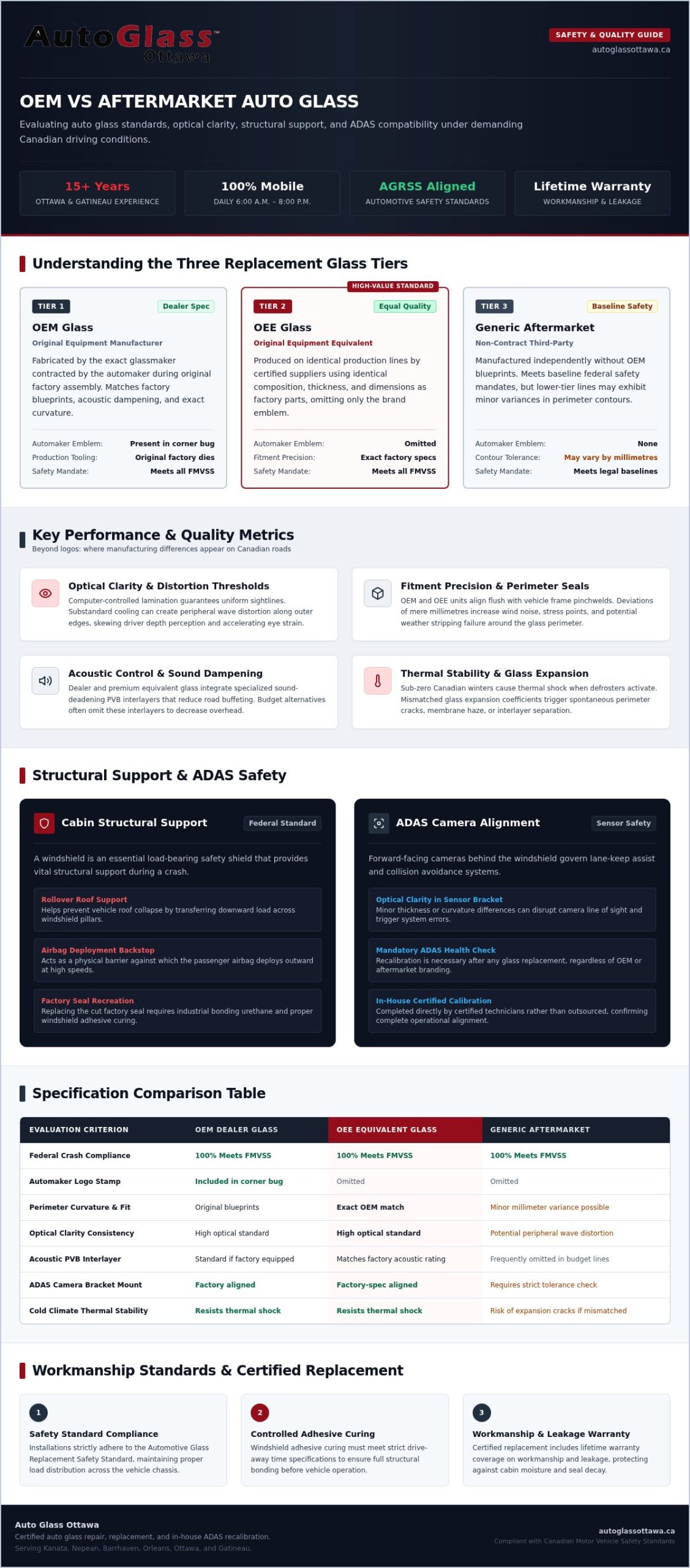
When assessing OEM vs aftermarket auto glass quality, drivers often assume that any windshield missing a dealership logo is an unsafe compromise. Automotive replacement glass actually falls into three clear tiers: Original Equipment Manufacturer, Original Equipment Equivalent, and non-contract aftermarket. Regardless of branding, every piece of road-legal glass sold in North America must comply with strict Federal Motor Vehicle Safety Standards to guarantee crash protection.
Understanding Original Equipment Manufacturer Glass Specifications
An Original Equipment Manufacturer (OEM) windshield is built by the exact glassmaker contracted to supply parts for a vehicle make and model during factory assembly. These units mirror original vehicle blueprints, matching identical curvature, optical clarity, tint colour, and acoustic dampening properties. The defining mark of OEM glass is the automaker’s brand emblem printed directly beside the glass manufacturer’s stamp in the corner bug.
Examining Original Equipment Equivalent and Aftermarket Alternatives
Original Equipment Equivalent (OEE) glass provides the exact same composition, thickness, and dimensions as factory parts. Established glass fabricators often produce OEE glass on identical production lines as dealer stock, simply omitting the automaker’s trademarked logo. Independent aftermarket glass, however, comes from third-party manufacturers without automaker supply contracts. While this glass meets baseline safety mandates, lower-tier aftermarket options demand careful quality checks to prevent minor perimeter variances that could compromise weather stripping or create wind noise.
Preserving Vehicle Integrity and the Factory Seal
A new vehicle leaves the assembly line with a pristine factory seal that bonds glass directly to the steel pinchwelds. When a damaged windshield is cut out, that initial bond is permanently broken. Recreating that bond demands certified technicians who strictly adhere to the Automotive Glass Replacement Safety Standard. Using high-grade urethane bonding systems, professional installers restore cabin rigidity so the glass delivers proper structural support during an impact. Ultimately, disciplined installation technique and proper adhesive curing matter just as much as the brand stamped on the glass.
Comparing OEM vs Aftermarket Auto Glass Quality Standards
Evaluating OEM vs aftermarket auto glass quality requires looking beyond brand stamps to physical performance metrics. While both options meet mandatory federal crash baselines, differences show up in glass curvature, surface resistance, and visual fidelity over years of driving. A lower-tier replacement might save upfront expenses, but minor manufacturing tolerances create lasting headaches if the glass fails to seal flush against the frame.
- Optical clarity: Premium glass guarantees flat, uniform sightlines, while substandard sheets can introduce peripheral wave distortion.
- Fitment precision: OEM and OEE parts follow exact perimeter contours; generic aftermarket glass may vary by millimetres, increasing wind turbulence.
- Acoustic control: Dealer glass frequently integrates sound-deadening PVB interlayers that lower-tier aftermarket glass often omits to cut manufacturing overhead.
- Surface resilience: High-grade automotive laminate withstands gravel abrasion and fine pitting from highway salt much longer than generic alternatives.
Optical Clarity and Visual Distortion Thresholds
Uniform lamination prevents visual artifacts across curved glass perimeters. Budget aftermarket glass occasionally exhibits waviness along outer edges where bending presses cool unevenly. That distortion skews driver depth perception and accelerates eye strain during long commutes. Premium equivalents eliminate this issue through computer-controlled optical checks, ensuring drivers receive crisp, clear vision identical to original dealer specifications.
Thermal Stability and Glass Expansion Coefficients in Cold Climates
Sub-zero Canadian winters push automotive laminates to their limits. Blasting hot defrosters against a freezing windshield creates extreme thermal shock. If replacement parts fail to match vehicle glass expansion coefficients, opposing thermal stresses lead to spontaneous perimeter cracking. High-grade thermal stability preserves interlayer adhesion, preventing inner plastic membranes from separating, hazing, or clouding after consecutive freeze-thaw cycles.
Fitment Precision and Windshield Adhesive Curing
Correct curvature ensures the glass rests naturally in the frame without physical force. Forcing an ill-fitting aftermarket pane into position loads residual tension directly into the bond line. Professional technicians adhering to the Auto Glass Replacement Safety Standard (AGRSS) select urethane formulations specifically calculated for structural load transfer. Proper windshield adhesive curing guarantees the vehicle satisfies safe drive-away time requirements before returning to the road. If you suspect your current glass fits poorly or leaks air, schedule a certified mobile inspection through autoglassottawa.ca to confirm cabin integrity.
Structural Support and ADAS Safety Considerations
A vehicle windshield does far more than shield you from road debris; it acts as a primary safety component. In a collision or rollover, auto glass supplies critical structural support, contributing up to 45 percent of a vehicle cabin’s structural strength. If a low-grade replacement fails to transfer crash energy across the pillars, the cabin roof faces an elevated risk of collapse. Front passenger airbag deployment also depends directly on the glass, as the airbag strikes the windshield surface at high velocity to cushion occupants. Without rigid glass and a certified urethane bond, the passenger-side airbag cannot deploy at its intended angle.
Forward Camera Calibration and Optical Pitch Accuracy
Modern crash-avoidance technology has permanently changed windshield replacement standards. Advanced Driver Assistance Systems (ADAS) rely on optical sensors and forward-facing cameras mounted flush against the glass to monitor lane markers, cyclists, and unexpected road hazards. While these driver aids protect motorists, the Insurance Institute for Highway Safety confirms that crash avoidance systems complicate repairs when glass must be replaced.
When comparing OEM vs aftermarket auto glass quality, optical glass uniformity directly affects camera performance. Tiny variances in glass thickness, subtle tint gradients, or slightly misaligned mounting brackets can refract incoming light. Even a single degree of camera pitch deviation skews the vehicle’s computer vision algorithms by several metres down the road. To avoid false braking events or delayed lane alerts, certified technicians run an in-house ADAS health check and recalibrate forward cameras to manufacturer specifications, ensuring collision mitigation systems respond accurately.
Professional Standards and Safety Compliance
Protecting your vehicle’s factory engineering requires strict compliance with the Automotive Glass Replacement Safety Standard. Following this framework guarantees that primers, glass preps, and structural urethanes cure to exact load-bearing requirements before you drive away. Reputable technicians complete a thorough vehicle inspection and full glass debris cleanup to ensure no hazardous fragments remain inside the cabin or ventilation ducts. If your company operates service vehicles or delivery vans, review specific commercial safety protocols in our guide to commercial fleet auto glass in Ottawa.
Insurance Policies, Warranty Coverage, and Total Value
Insurance coverage often dictates which replacement parts go onto your vehicle. When comparing OEM vs aftermarket auto glass quality from an insurance perspective, standard policies focus on returning your vehicle to its pre-loss condition using parts of like kind and quality. This mandate means Ontario adjusters routinely approve high-grade OEE or aftermarket glass rather than parts stamped with an automaker badge. Understanding the intersection of policy wording, warranties, and technician craft helps you protect both your budget and your safety.
Understanding Comprehensive Deductibles and OEM Endorsements
Auto glass damage typically falls under your comprehensive insurance coverage. If you need a total replacement, you are responsible for paying your agreed comprehensive deductible unless your policy features a deductible waiver. Drivers who insist on brand-stamped glass must usually purchase an optional OEM replacement endorsement ahead of time, typically available for vehicles under five years old. To review Ontario claim requirements step by step, check our guide on insurance windshield replacement in Ottawa before initiating paperwork.
Installer Workmanship Guarantees vs Manufacturer Warranties
A glass manufacturer’s warranty covers material flaws, such as internal laminate bubbles, surface distortion, or stress cracks originating from factory production defects. However, it offers zero protection against air whistles, water leaks, or rust. For true peace of mind, you need an installer-backed lifetime warranty on workmanship and leakage. Expert technicians use ultrasonic leak detectors during post-installation checks to verify that every bead of urethane creates an airtight, watertight barrier before releasing the keys.
Preventing Air Leaks, Water Intrusion, and Defect Notices
Poor installation technique carries serious consequences beyond annoying wind noise:
- Corrosion risks: Careless technicians who scratch pinchweld paint during old glass removal trigger rust that eats through vehicle frames beneath the urethane.
- Legal compliance: Compromised glass installation can prompt a safety official to issue an Equipment Defect Notice, requiring immediate off-road repairs.
- Electronic faults: Unsealed upper channels allow rain inside dashboard electronics, shorting out body control modules.
A dealership logo cannot compensate for sloppy installation. Focus on hiring certified installers who guarantee factory-level precision and handle the administrative burden for you. If you need help filing your glass claim or want to verify your policy coverage, book professional insurance claim assistance with Auto Glass Ottawa to ensure a smooth, worry-free replacement.
How to Decide Between OEM and Aftermarket Glass for Your Car
Choosing between replacement options comes down to your vehicle’s design, your daily driving habits, and your ownership terms. Evaluating OEM vs aftermarket auto glass quality is not merely about brand preference; it requires matching the right glass grade to your car’s technological demands and warranty obligations.
Step 1: Check Vehicle Age, Lease Terms, and Display Features
Start by reviewing your vehicle paperwork and onboard options:
- Lease contracts: Dealership return agreements frequently stipulate that turned-in vehicles must carry authentic OEM parts, including brand-stamped glass, to avoid penalty fees at lease maturity.
- Heads-up displays: If your vehicle projects speed or turn-by-turn navigation onto the windshield, selecting OEM or strict OEE glass is vital. Lower-grade alternatives lack the wedge-shaped interlayer required to prevent distracting double images.
- Daily commuters: For vehicles past their bumper-to-bumper warranty without projection displays, certified aftermarket or OEE glass delivers dependable durability and optical clarity while lowering replacement expenses.
Step 2: Verify Technician Certifications and Mobile Service
Even premium glass fails to protect vehicle occupants if bonded incorrectly. Always confirm that your chosen installer employs certified technicians who follow rigorous Auto Glass Safety Council standards. You also do not need to disrupt your work schedule sitting in a dealer waiting room. Established service teams deploy fully equipped mobile units capable of completing shop-grade replacements directly in residential driveways and office lots across Kanata, Nepean, Barrhaven, Orleans, Ottawa, and Gatineau.
Step 3: Book Your Replacement with Auto Glass Ottawa
With over 15 years of regional experience, our certified technicians take the guesswork out of auto glass replacement. We deliver 100% free mobile service operating daily from 6:00 a.m. to 8:00 p.m., bringing certified installation straight to your driveway. We carry high-quality OEM and equivalent glass, execute precision in-house ADAS camera recalibrations, and back every job with a lifetime warranty on workmanship and leakage. Contact Auto Glass Ottawa to schedule your mobile service and restore complete structural safety to your vehicle.
Restore Your Vehicle Safety with Certified Glass Replacement
Navigating OEM vs aftermarket auto glass quality ultimately comes down to optical precision, certified fitment, and expert installation. While dealer-stamped glass delivers factory pedigree, premium OEE options supply identical structural support and durability without unnecessary expense. Regardless of the glass grade you choose, your safety depends on proper adhesive curing and meticulous sensor alignment.
You don’t need to lose half your workday waiting at a dealership. Backed by over 15 years of regional experience serving Ottawa and Gatineau drivers, our team brings shop-grade repairs directly to your driveway or workplace. We offer 100% free mobile service operating daily from 6:00 a.m. to 8:00 p.m., with certified specialists handling in-house ADAS camera recalibration on the spot. Every replacement includes a lifetime warranty against workmanship defects and water leakage, ensuring you drive away protected against harsh Canadian weather. Book your free mobile windshield replacement with Auto Glass Ottawa today and get back on the road with total confidence.
Frequently Asked Questions
Does aftermarket auto glass void my vehicle manufacturer warranty?
No, installing aftermarket auto glass will not void your overall vehicle warranty. Canadian consumer protection principles prevent automakers from voiding vehicle coverage simply because you choose aftermarket or equivalent replacement parts. A warranty claim can only be denied if an inferior installation or substandard glass directly damages an adjacent vehicle component. Choosing certified technicians who provide a lifetime warranty on workmanship protects your vehicle completely.
Will aftermarket glass cause problems with my forward ADAS safety camera?
High-quality aftermarket and equivalent glass will not interfere with safety cameras if properly calibrated. Complications only develop when low-grade glass contains optical distortions or misaligned mounting brackets. When evaluating OEM vs aftermarket auto glass quality, optical precision matters. Following any installation, certified technicians perform a detailed ADAS health check and recalibrate forward cameras to manufacturer specifications, ensuring collision mitigation systems respond accurately.
Can minor stone chips be repaired instead of replacing the entire windshield?
Yes, minor stone chips can often be repaired if addressed before cracks begin spreading across the glass. Most repairable windshield chips smaller than a two-dollar coin and positioned outside the driver’s direct sightline qualify for resin treatment. Technicians inject industrial-strength resin directly into the impact point, restoring structural integrity and visual clarity while keeping your factory seal intact.
Why does OEM auto glass cost more than aftermarket glass?
OEM glass carries higher pricing because of automaker branding royalties, dealer distribution networks, and exclusive vehicle manufacturer licensing agreements. Automakers do not manufacture their own glass; they contract major glassmakers who produce the parts with an official automaker emblem. Equivalent aftermarket manufacturers produce matching glass designs on parallel assembly lines, passing substantial distribution savings along to vehicle owners without compromising core durability.
How long does windshield adhesive curing take before I can safely drive?
Safe drive-away times generally range between 30 and 60 minutes after glass installation is completed. High-grade urethane bonding systems rely on ambient humidity to complete initial windshield adhesive curing and secure the glass directly to the frame. Operating a vehicle before the adhesive reaches structural strength risks glass shifting and compromises cabin safety, so your technician will specify the exact safe drive-away window.
Is aftermarket glass safe during a rollover accident or collision?
Yes, certified aftermarket auto glass is completely safe and satisfies all mandatory Federal Motor Vehicle Safety Standards. Windshields provide vital structural support during rollover incidents and absorb passenger airbag deployment forces during front-end impacts. When assessing OEM vs aftermarket auto glass quality, actual crash protection relies on technician bonding procedures and urethane strength rather than the presence of an automaker logo.
How do I know if my auto insurance covers OEM glass replacement?
You can verify OEM glass eligibility by checking your policy declarations page or asking your insurance representative about specific OEM endorsements. Standard policies across Canada typically cover replacement using parts of like kind and quality, which frequently means high-grade equivalent glass. If you prefer brand-stamped glass, you must carry an optional OEM replacement rider, after which your standard comprehensive deductible applies.