
Is It Illegal to Drive with a Cracked Windshield in Ontario?
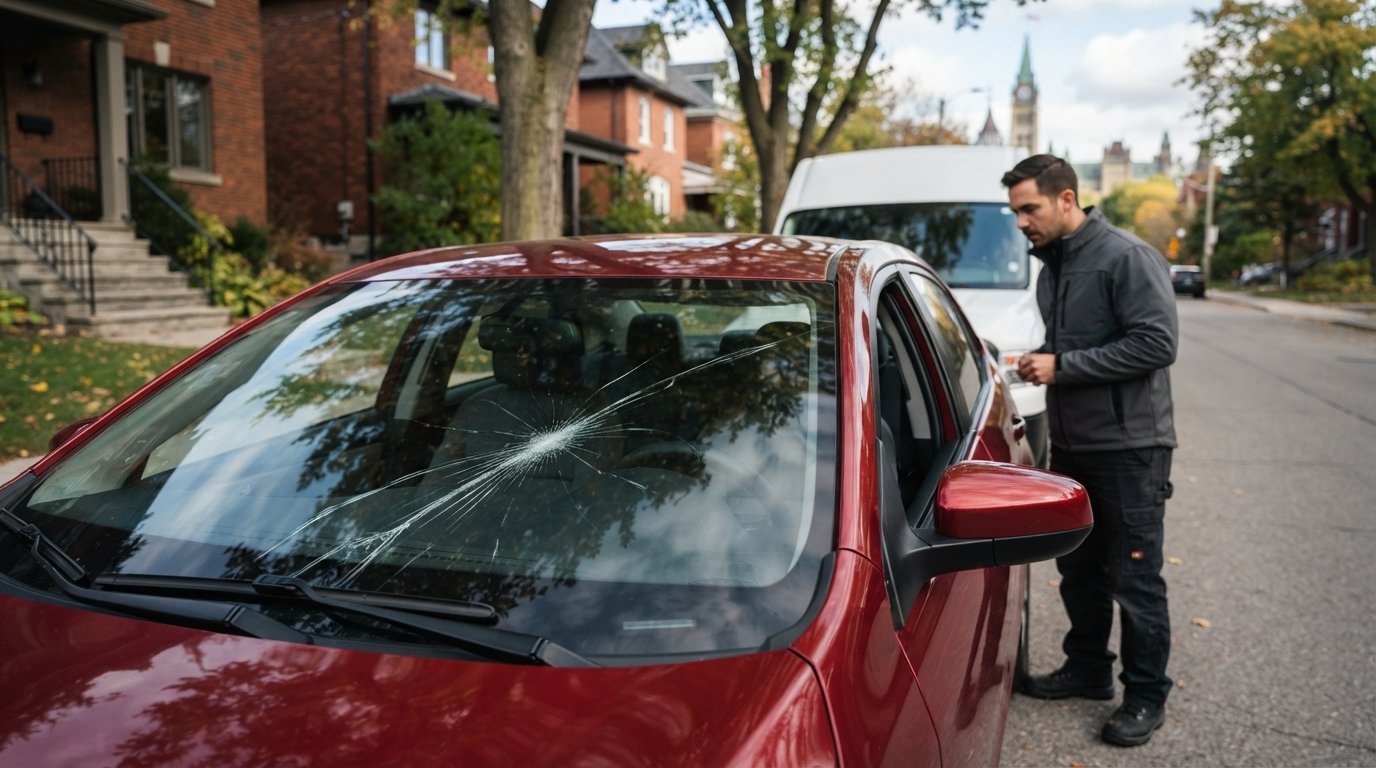
When a stone chip suddenly spreads across your glass on the highway, you might immediately ask: is it illegal to drive with a cracked windshield Ontario police will pull you over for? Many drivers assume any visible blemish breaks provincial law, but Ontario regulations specifically target driver visibility and vehicle safety rather than minor cosmetic flaws. Still, you shouldn’t have to spend your daily commute anxiously scanning your rear-view mirror for cruisers, worrying whether a spreading fracture compromises your cabin’s structural support in a crash, or wondering how your insurance policy handles repairs.
In this guide, you will learn the exact Ontario Highway Traffic Act rules, the real safety risks of driving with damaged auto glass, and your repair options. We will break down provincial safety inspection thresholds, clarify when officers issue an Equipment Defect Notice, and explain how to restore your vehicle’s integrity through convenient mobile repair that protects your safety without disrupting your day.
Key Takeaways
- Clarify whether is it illegal to drive with a cracked windshield Ontario officers can ticket by reviewing Highway Traffic Act visibility requirements.
- Identify how damage size and position, especially within the driver’s forward wiper path, dictate whether glass passes provincial safety standards.
- Discover why a compromised windshield threatens passenger airbag deployment and reduces cabin structural support during a rollover collision.
- Learn how Canadian winter freeze-thaw cycles rapidly spread small damage and why forward-facing cameras require precise ADAS camera recalibration.
- Explore straightforward repair solutions, including insurance claim assistance with a deductible waiver and free mobile service at your home or workplace.
Ontario Highway Traffic Act: What the Law Says About Cracked Windshields
If you are wondering whether is it illegal to drive with a cracked windshield Ontario law does not ban cracked auto glass outright. Instead, the provincial legal framework focuses on driver line of sight and overall vehicle roadworthiness. Under Ontario’s Highway Traffic Act regulations, including Section 84 and Section 74(1)(a), operating a motor vehicle is prohibited unless the front windshield and side windows afford the driver a clear, unobstructed view of the road ahead and to both sides. Any blemish that obstructs, distorts, or refracts light across the driver’s forward vision violates this legal requirement.
Highway Traffic Act Regulations on Driver Visibility
Ontario traffic safety laws require complete optical clarity through modern automotive laminated safety glass. While a minute stone chip on the far passenger corner rarely draws scrutiny, cracks running across the primary viewing area directly above the steering wheel create immediate hazards. These fractures actively split oncoming headlight beams at night and reflect intense sunlight during the day, producing severe glare that can blind you at critical driving moments. Because of these safety hazards, police officers look closely at any visible fracture entering the path cleared by your windshield wipers, exercising full statutory discretion to decide if the damage poses an active visual obstruction.
Potential Fines, Demerit Points, and Equipment Notices
Getting pulled over for damaged auto glass can disrupt your routine quickly. Here is what happens when law enforcement flags your windshield during a roadside stop:
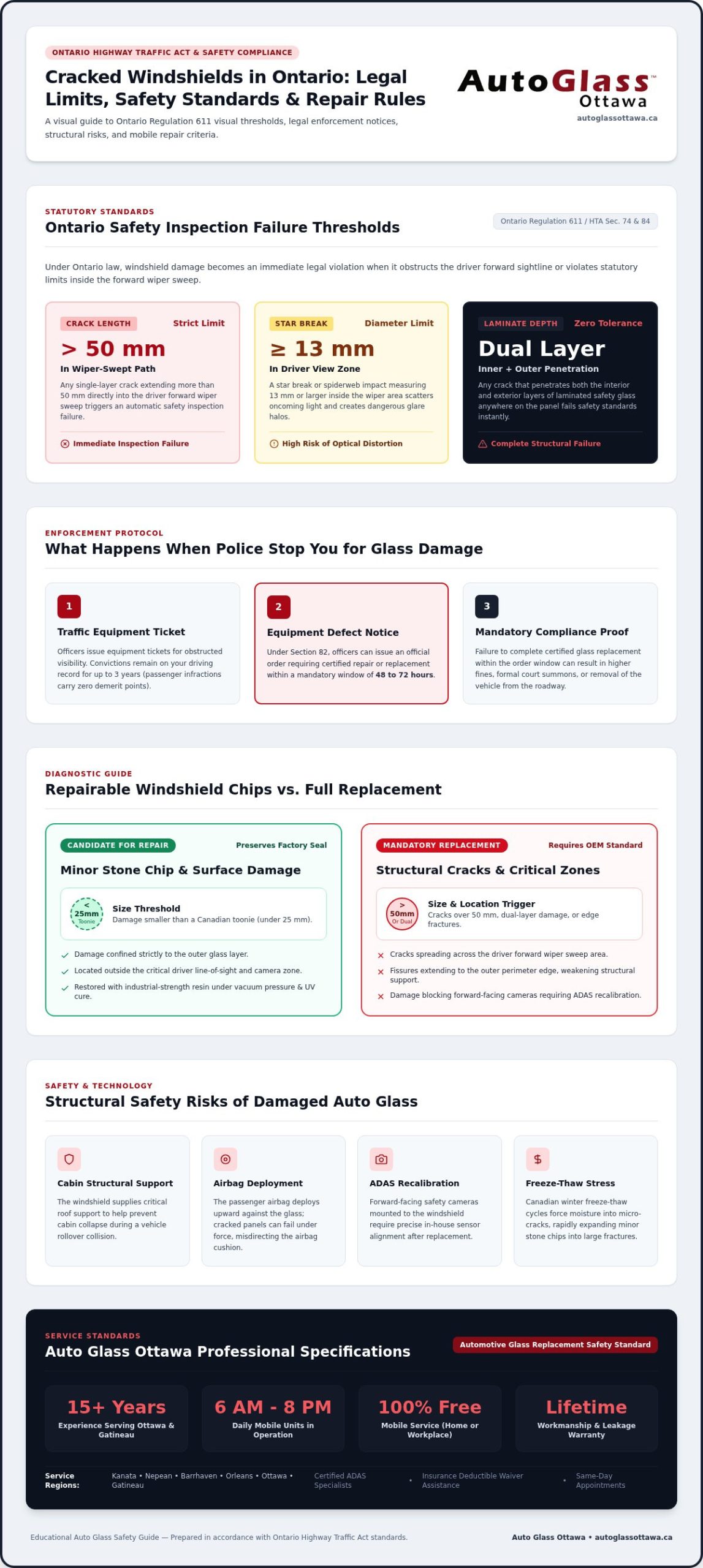
- Traffic equipment tickets: Convictions for obstructed visibility under provincial equipment rules carry set monetary fines and stay on your driving record for up to three years, though passenger vehicle infractions do not assess demerit points.
- Official Equipment Defect Notice: An officer inspecting noticeable visual disruption may issue an Equipment Defect Notice under Section 82. This order legally mandates that you repair or replace the safety glass within a strict operational window, usually 48 to 72 hours.
- Mandatory compliance proof: Failing to complete certified glass service within the specified timeframe can result in higher fines, a formal court summons, or the removal of your vehicle from the roadway until it meets provincial safety standards.
When you understand the exact thresholds police use on local roads, answering whether is it illegal to drive with a cracked windshield Ontario drivers face comes down to damage position and visibility impact. If severe damage or an enforcement order leaves your vehicle unsafe to operate on the road, emergency roadside assistance from Citywide Towing can safely transport your car directly to a certified repair facility.
Evaluating Windshield Damage: Minor Stone Chip or Immediate Legal Violation?
Self-diagnosing your auto glass helps clarify where your vehicle stands under provincial guidelines. While a tiny surface pit might seem harmless, structural cracks spreading across glass layers require immediate attention. Under the Ontario Highway Traffic Act, damage becomes legally actionable the moment it compromises your forward sightline. Ontario Regulation 611 sets strict, measurable safety thresholds: a vehicle fails inspection if a single-layer crack extends more than 50 mm into the wiper-swept path, if a star break reaches 13 mm or larger in that zone, or if any crack penetrates both the inner and outer glass layers anywhere on the panel.
The Critical Driver Field of View Zone
The primary viewing area directly above your steering wheel receives the closest scrutiny from safety inspectors and police. Because this zone aligns with your direct driving sightline, any spiderweb fracture or spreading fissure here distorts depth perception and scatters artificial light. During night drives, oncoming high beams turn small fissures into blinding halos. This distraction significantly delays braking reactions, explaining why provincial safety standards maintain zero tolerance for optical defects inside the driver’s forward wiper path.
Crack Length, Chip Depth, and Repairable Windshield Chips
Determining whether you need a quick repair or a complete replacement depends on physical size, depth, and edge proximity:
- Repairable windshield chips: Impact blemishes smaller than a Canadian toonie (under 25 mm) that remain on the outer layer are ideal candidates for repair. Technicians inject industrial-strength resin under vacuum pressure, curing it with ultraviolet light to restore optical clarity and halt crack propagation.
- Edge fractures: Any crack that begins at or reaches the outer perimeter of the glass compromises structural integrity and cannot be stabilized with resin alone.
- Penetrating breaks: If damage punches through the plastic interlayer to the inner cabin glass, structural rigidity is gone, requiring immediate glass replacement.
If you spot a minor blemish on your glass, booking a prompt mobile assessment through Auto Glass Ottawa can stop the fracture before changing temperatures push it past the repair threshold. Knowing these precise criteria gives you the exact answer to whether is it illegal to drive with a cracked windshield Ontario inspectors will fail, helping you take decisive action before a routine commute turns into a roadside ticket.
Structural Safety Risks: Beyond Visual Obstruction and Driving Fines
Drivers frequently ask whether is it illegal to drive with a cracked windshield Ontario officers will cite, but the physical hazards of driving with damaged safety glass extend far past a traffic ticket. Modern vehicle engineers design front auto glass as an integral structural element rather than a simple cosmetic shield. When an untreated fracture weakens the panel, you compromise the vehicle’s structural stability, placing everyone inside the cabin at serious risk if a collision occurs.
Vehicle Cabin Structural Support and Rollover Defence
Your windshield delivers vital structural support that preserves the occupant survival space during a catastrophic crash. According to the Auto Glass Safety Council, a properly bonded front windshield provides up to 45% of a vehicle cabin’s structural strength in a head-on collision and up to 60% of structural roof support during a rollover accident. When technicians install auto glass adhering to Federal Motor Vehicle Safety Standards, high-strength urethane bonds the glass directly to the frame. A deep crack breaks this load-bearing continuity, reducing overall torsional rigidity and increasing the danger that the roof will crush inward if the car flips.
Airbag Deployment Mechanics and Passenger Security
In a severe frontal impact, the front passenger airbag deploys upward against the inside of the windshield in roughly 20 to 30 milliseconds. The glass acts as a sturdy backstop, deflecting the airbag outward to cushion the passenger. If fractures weaken the glass or damage the factory seal, the violent expansion can push the windshield out of its frame or shatter it entirely. This causes the airbag to deploy out of position, stripping away vital protection.
Modern windshields also serve as the optical mounting base for critical crash-prevention hardware. As highlighted in IIHS research on crash avoidance systems, proper glass integrity and sensor placement are essential for automatic emergency braking and lane assist to operate reliably. Replacing damaged glass in compliance with the Automotive Glass Replacement Safety Standard guarantees that your passive and active collision protections function exactly as designed. Beyond the question of whether is it illegal to drive with a cracked windshield Ontario roads demand, structural integrity remains the highest priority for your family’s safety.
Weather Extremes and ADAS Camera Recalibration Realities
Harsh Canadian weather transforms minor glass imperfections into urgent driving hazards within hours. If you are debating whether is it illegal to drive with a cracked windshield Ontario winter conditions often settle the debate for you. Sub-zero temperatures and high cabin heat rapidly force hairline fissures across your entire sightline, turning an isolated blemish into an undeniable ticket risk and an active safety hazard.
How Ontario Freezing Temperatures Accelerate Crack Growth
Road spray, slush, and moisture constantly settle into every exposed stone chip. When the temperature drops below freezing, trapped water expands, wedging the glass layers apart from the inside out. Cranking your defroster to maximum heat on a frosty morning creates instant thermal shock. Because of conflicting glass expansion coefficients between the frozen outer pane and the rapidly warming inner pane, the laminate loses its thermal stability. Industry testing demonstrates that a minor chip exposed to Canadian winter freeze-thaw cycles and direct cabin defrosting has an 80% likelihood of suddenly splintering into an unrepairable fracture across the glass panel.
Modern Vehicle Sensors and In-House Camera Recalibration
Over 90% of modern passenger vehicles now feature forward-facing cameras mounted flush against the upper windshield. These optical sensors govern vital driver-assist technology, including Lane Keep Assist, Automatic Emergency Braking, and adaptive cruise control. When a crack creeps across the camera’s field of view, it refracts light and distorts optical data. This optical distortion can disengage automated safety features or trigger dangerous false emergency braking on busy highways.
Whenever you replace a windshield fitted with safety glass sensors, technicians must conduct a thorough ADAS health check. Certified technicians perform both static target alignment and dynamic road tests to verify that every sensor matches manufacturer specifications. If you oversee commercial assets, learn more about fleet safety in our commercial fleet auto glass guide.
Never leave optical sensor precision to chance. Book certified windshield replacement with in-house recalibration to restore your vehicle’s advanced safety systems without unnecessary dealership delays.
Resolving Windshield Damage Conveniently: Repair, Replace, and Insurance
Mobile Service Convenience at Home or Office
Modern mobile auto glass units bring certified technicians directly to your residential driveway or office parking lot. This eliminates the safety risk of driving across town with severely impaired vision or compromised structural glass. Mobile service vans carry OEM-grade materials, precision primers, and high-performance adhesives to match workshop installation standards on-site. Once the technician sets the glass, proper windshield adhesive curing is critical. High-modulus urethanes need dedicated cure time before the vehicle is safe to drive, ensuring the factory seal bonds correctly to support airbag loads. For a detailed breakdown of policy coverage and claim procedures, explore our complete guide on insurance windshield replacement in Ottawa.
Insurance Claim Support and Certified Workmanship
Handling glass claims is straightforward when you know how provincial auto policies operate. Most Ontario comprehensive auto insurance packages actively encourage proactive glass care, providing a full deductible waiver for minor resin chip repairs. This means you can often fix small impacts before they turn into windshield-wide fractures without paying an out-of-pocket comprehensive deductible. When full replacement is necessary, working with an established provider ensures direct billing and seamless paperwork processing with all major Canadian insurers.
Certified technicians trained under strict industry standards execute every replacement using premium materials backed by a lifetime warranty on workmanship and leakage. This guarantees your safety glass remains airtight, watertight, and structurally sound for as long as you own the vehicle. Instead of stressing over whether is it illegal to drive with a cracked windshield Ontario authorities will penalize you for, connect directly with Auto Glass Ottawa to schedule fast mobile service that restores your road visibility and vehicle protection.
Restore Clear Vision and Cabin Safety on Ontario Roads
Answering whether is it illegal to drive with a cracked windshield Ontario drivers face ultimately comes down to visibility and structural protection. While a small stone chip outside your line of sight won’t immediately trigger a ticket, leaving damage unattended invites serious risk. Deep cracks weaken your cabin’s rollover defence, interfere with proper airbag deployment, and distort the camera sensors that guide your vehicle’s driver-assist systems.
You don’t have to sacrifice your busy workday or risk driving with compromised glass to keep your vehicle roadworthy. Auto Glass Ottawa brings complete auto glass care directly to your residential driveway or office parking lot with 100% free mobile service across Ottawa and Gatineau. Our certified technicians adhere to strict Auto Glass Safety Council standards, handle camera recalibration in-house, and back every replacement with a lifetime warranty on workmanship and leakage.
Restore your vehicle safety with certified mobile windshield repair from Auto Glass Ottawa today and enjoy absolute peace of mind behind the wheel.
Frequently Asked Questions
Can Ontario police pull me over solely for a cracked windshield?
Yes, Ontario police can initiate a traffic stop solely because of a damaged windshield if the damage visibly impedes your field of view. Under the Highway Traffic Act, officers have statutory discretion to pull over any vehicle displaying glass fractures that obstruct forward or side lines of sight. When debating whether is it illegal to drive with a cracked windshield Ontario law enforcement focuses strictly on driver sightlines and road hazard potential.
Will a cracked windshield fail an Ontario safety inspection?
Yes, your vehicle will fail an Ontario safety inspection if the damage exceeds regulatory limits under Ontario Regulation 611. Specifically, any single-layer crack extending more than 50 mm into the wiper-swept path, any star chip exceeding 13 mm in that area, or any crack penetrating both glass layers fails immediately. Technicians inspect these dimensions carefully, requiring complete glass replacement before issuing a valid safety certificate.
Does comprehensive auto insurance cover windshield crack repairs in Ontario?
Yes, most Ontario auto policies with physical damage coverage handle glass damage. Insurers typically apply a deductible waiver for repairable windshield chips, meaning technicians can restore the blemish with industrial-strength resin without requiring you to pay your policy’s comprehensive deductible. However, if damage has already spread across the glass and requires a complete replacement, your standard comprehensive deductible will apply toward the new installation.
How fast will a small stone chip turn into a full windshield crack?
A small stone chip can spread into a massive fracture within minutes, especially during extreme temperature shifts. Blasting high heat onto a frozen windshield in an Ottawa winter causes severe thermal shock due to differing glass expansion coefficients. Driving over speed bumps, hitting potholes, or experiencing sudden cabin pressure changes from closing doors can also trigger immediate spidering, quickly destroying your auto glass.
Can a cracked windshield affect my vehicle forward-facing ADAS cameras?
Yes, fractures crossing the upper windshield disrupt the optical line of sight for forward-facing cameras. Modern safety systems rely on precise clarity to monitor lane markings and upcoming hazards. Cracks refract light and confuse camera sensors, triggering system disengagement or false emergency braking. Following any windshield replacement, certified technicians must perform an ADAS health check and static or dynamic recalibration to restore proper safety functions.
What is an Equipment Defect Notice under the Ontario Highway Traffic Act?
An Equipment Defect Notice is an official compliance directive issued by police under Section 82 of the Highway Traffic Act. Rather than writing an immediate fine, the officer gives you a strict timeline, typically 48 to 72 hours, to repair or replace the defective glass. To settle whether is it illegal to drive with a cracked windshield Ontario drivers must present certified repair proof to clear the notice.