
How to Read a Windshield Crack: Understand Its Shape, Direction, and Location
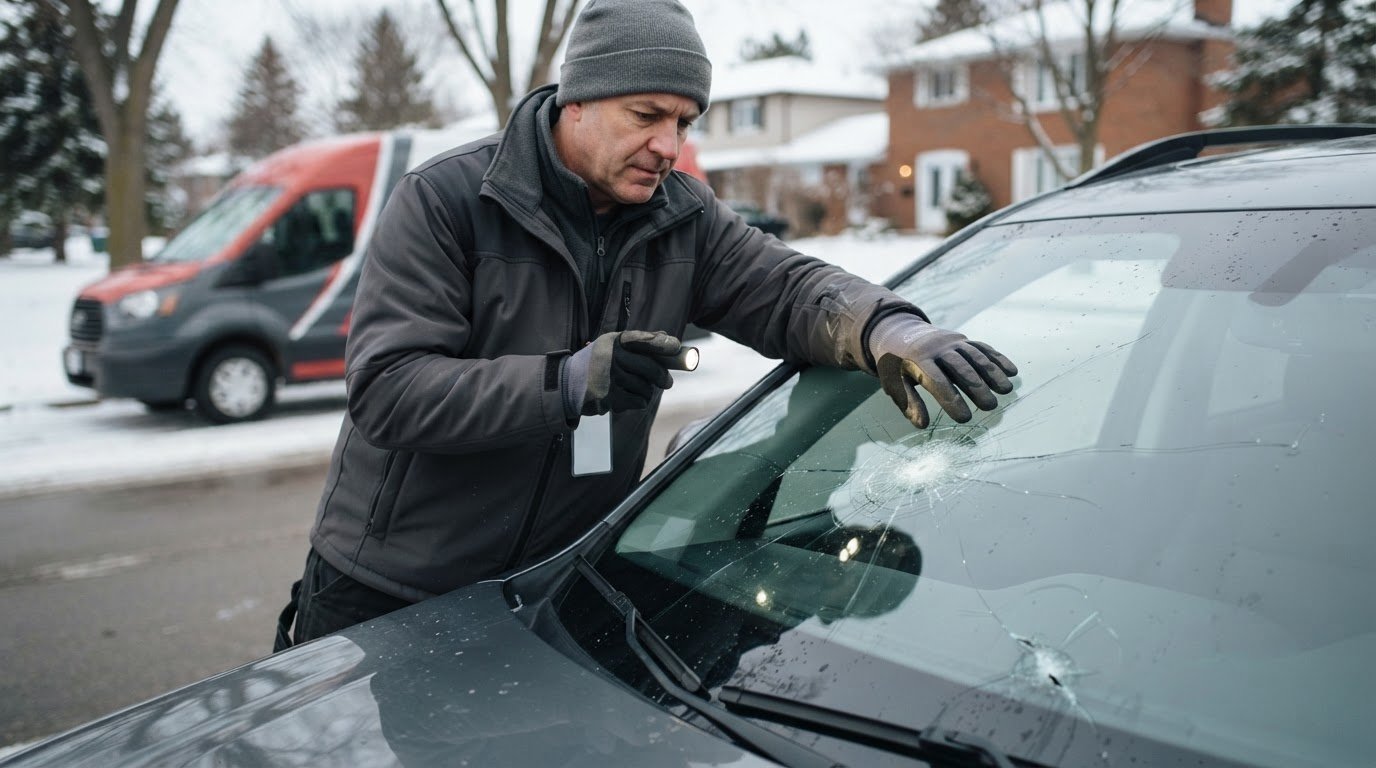
Could a short-looking crack near the windshield edge matter more than a longer line elsewhere? The shape and direction offer useful clues, but they can’t confirm how serious the damage is. If you’re trying to work out how to read a windshield crack, it’s understandable to feel unsure: unfamiliar patterns can be hard to identify, and glare or a change in viewing angle can make them look different.
This guide shows you how to describe visible features, where the damage starts and travels, and what those details can’t tell you on their own. Note whether a crack branches, curves, runs toward the edge, or sits in your line of sight, without treating its appearance as a diagnosis. A certified technician considers the damage’s position and condition to determine whether repair or replacement is appropriate. Windshield damage can affect visibility and structural support, so clear observations are a useful first step. Auto Glass Ottawa offers free mobile service at homes and workplaces across Ottawa and Gatineau, so you can arrange an assessment without a separate trip to a shop.
Key Takeaways
- To learn how to read a windshield crack, note its visible shape, direction, and endpoints without treating its pattern as a diagnosis.
- Distinguish a line extending through the glass from a localized stone chip, and describe the damage you can see.
- Record whether the crack is near the edge, in your central viewing area, or elsewhere on the windshield. Location informs an assessment but can’t confirm safety or repairability on its own.
- Take clear photos from inside and outside when conditions allow, and share them with a brief description of the damage.
- A certified technician can assess the windshield and discuss repair or replacement options. Auto Glass Ottawa provides free mobile service at homes and workplaces in Ottawa and Gatineau.
How to Read a Windshield Crack: Start with What You Can See
You can describe a windshield crack without knowing exactly how serious it is. Start with three visible details: its pattern, the direction it travels, and its position on the glass. These observations help a technician understand what you’re seeing, but they can’t reveal the windshield’s full condition or prove it’s safe to drive.
Windshields provide visibility and contribute to vehicle safety. This overview of windshield construction and safety can help explain why damage deserves attention. Focus on describing the marks you can see rather than deciding whether they can be repaired.
What counts as a crack rather than a stone chip?
A stone chip is a localized impact mark, often with a small central point or a shallow-looking blemish. A crack appears as a visible line extending through the glass from the impact area or another point. Damage can include both: a central mark with fine lines branching away from it. The pattern, or any single measurement, can’t establish whether the damage is repairable.
Keep your description simple. You might say, “There’s a small impact mark with two lines branching toward the passenger side,” or, “A narrow line runs from the lower edge toward the centre.” These descriptions report what’s visible without guessing at the damage beneath the surface.
Which viewing details should you record first?
Note where the damage sits from the driver’s seat, such as near the edge, low on the glass, or in the central viewing area. Then look from outside, if it’s safe to do so, and note the visible endpoints, branches, and any nearby impact marks. Don’t touch, press, or trace the damaged glass. Touching it won’t tell you whether the windshield is structurally sound.
Light can change what you notice. A line may stand out in bright daylight, look faint from inside, or seem to shift when you change your viewing angle. Record that observation instead of assuming the crack has changed. If you’re unsure where it ends, describe the last point you can clearly see.
Before seeking an assessment, jot down a few details:
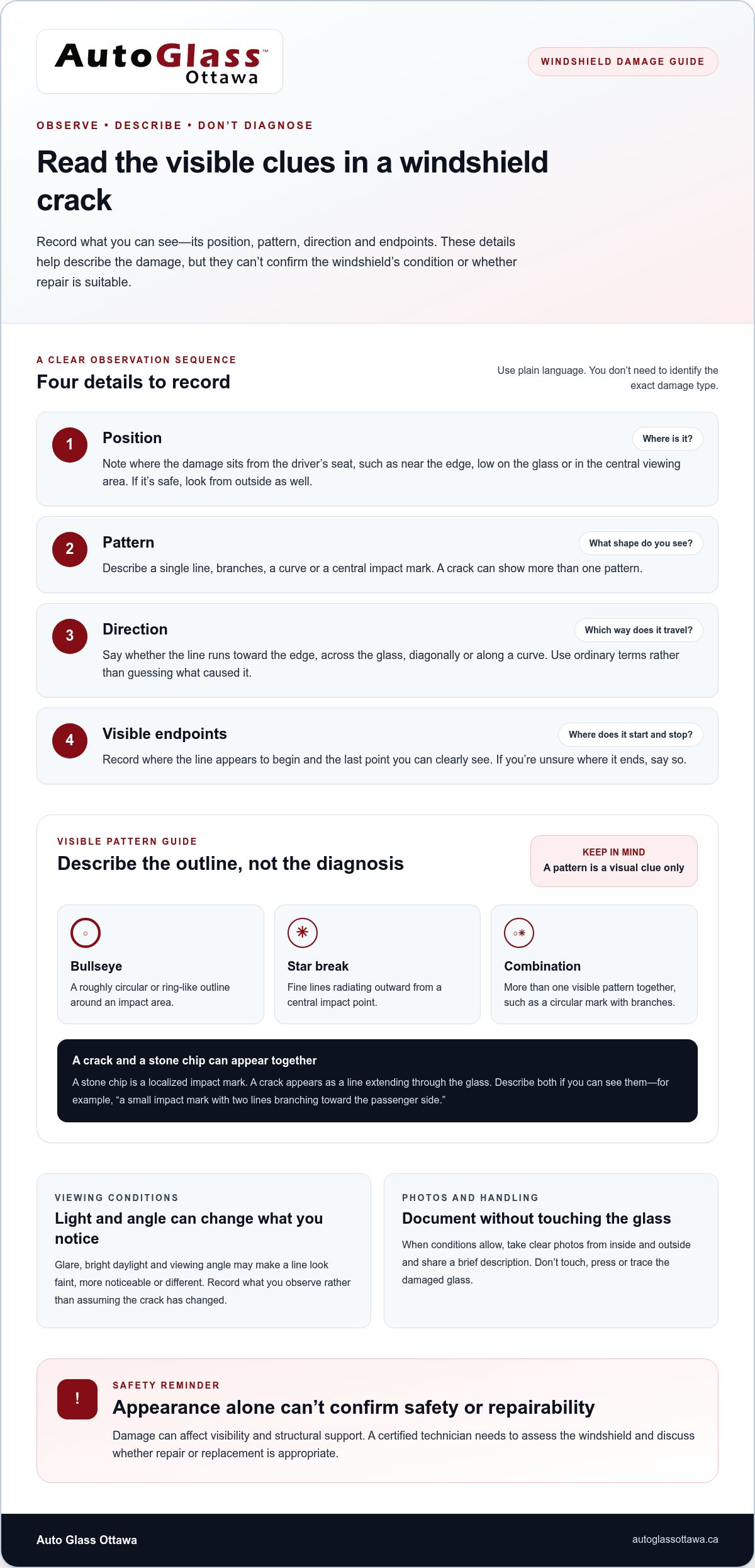
- Position: Describe the area from the driver’s seat and from outside.
- Pattern: Note whether you see a single line, branches, a curve, or a central impact mark.
- Direction: Say which way the line travels, such as toward the edge or across the glass.
- Endpoints: Record where the visible line begins and where it appears to stop.
That’s how to read a windshield crack for clear communication: observe, describe, and avoid treating appearance as a safety diagnosis. A certified technician still needs to assess the damage and discuss repair or replacement options. Your details give them a useful starting point.
Recognize Windshield Crack Shapes and Their Visible Patterns
Once you’ve noted where the damage sits, look at its outline. Names such as “bullseye” and “star break” are shorthand for patterns you can see, not a verdict on how deeply the glass is affected. A crack can combine several shapes, so a plain-language description is often more useful than trying to identify one exact category.
A crack pattern can help describe what you see, but it can’t diagnose the windshield’s safety or determine whether repair is suitable. Two marks with similar outlines may have different underlying damage. Use the labels below as visual guides, then report the pattern without treating its name as a repair recommendation.
How do bullseye, star, and combination patterns differ?
A bullseye looks roughly circular around an impact area. A star break has lines radiating outward from a central impact point, like spokes. Combination damage shows more than one recognizable pattern together, such as a circular area crossed by branching lines. These labels describe visible shapes only; they don’t establish the damage’s full extent.
- Bullseye: A rounded or ring-like outline around a central area.
- Star break: Several fine lines radiating away from a central impact area.
- Combination: Overlapping features, such as a circular mark with radiating branches.
For example, if you see a small round mark with several lines spreading from it, describe both parts: “circular impact mark with radiating branches.” That gives a clearer picture than relying on a label alone. If the centre is difficult to see, say so rather than guessing where the lines begin.
What can a long, straight, or curved line suggest?
A long line may extend away from an impact area, while another may appear without an obvious central mark. It may look straight, curve gently, or change direction. These are useful observations to share, but shape alone can’t confirm what caused the line or how far the damage extends within the glass.
Describe the path in ordinary terms: “runs diagonally toward the passenger-side edge,” “curves upward from the lower section,” or “appears as a straight line with no visible impact point.” A photograph can document the outline, but reflections, glare, and viewing angle may hide fine branches or make a line look different. A certified technician needs to assess the windshield before discussing repair or replacement.
Windshield glazing is designed to meet performance requirements for visibility and occupant safety. The Federal Motor Vehicle Safety Standard for glazing materials is a U.S. reference on glazing performance, not a Canadian repair assessment. Its subject helps explain why a crack’s appearance alone can’t establish whether the glass still performs as intended.
If you’ve recorded the pattern but aren’t sure what it means for your windshield, arrange a professional windshield assessment. A technician can examine the damage and explain the appropriate next step.
Read the Crack’s Direction and Location Without Guessing at Safety
Where a crack sits and which way it travels are useful details to record, but neither gives you a reliable pass-or-fail test. A short line can still need attention, and damage that seems far from your direct view isn’t automatically harmless. To understand how to read a windshield crack, describe its position from the driver’s seat, then note whether it reaches an edge, crosses your viewing area, or sits higher or lower on the glass.
A crack’s visible position is one detail in a professional assessment, not a verdict on safety or repairability. The windshield contributes to a vehicle’s structural support, so a technician considers more than the line’s apparent length or location. The Auto Glass Safety Council’s Automotive Glass Replacement Safety Standard (AGRSS) outlines industry practices for auto glass work, including assessment and replacement procedures.
What does a crack near the windshield edge tell you?
Note whether the line appears to meet the windshield’s outer edge, runs alongside it, or stops before reaching it. Be specific without measuring or touching the glass: for example, “starts near the lower passenger-side edge” or “runs parallel to the top edge.” Don’t use a guessed distance from the edge to decide whether the damage is safe or repairable. The position is useful information for a technician, who can assess the glass and discuss the appropriate next step.
Cracks in other areas also deserve a clear description. Say whether the damage is in the upper section, lower section, or nearer the centre. A line toward the bottom may be harder to notice from the driver’s seat, while one higher up may stand out against a bright sky. These observations explain what you see in ordinary conditions; they don’t establish how the glass will perform.
Why note cracks in the driver’s viewing area?
From your normal seated position, check whether any part of the crack crosses the area you look through while driving. Describe what it does, such as “a line crosses the view ahead” or “the damage sits near the passenger side, outside my usual viewing area.” Don’t lean across the cabin or touch the glass to get a closer look.
Visibility can change with the light. Glare, reflections, overcast conditions, or a different viewing angle may make a line appear stronger or less noticeable. If that happens, record when you noticed the change rather than assuming the damage itself has shifted. No description from the driver’s seat can confirm the windshield is safe.
When you arrange an assessment, share the location and direction in plain language. Pairing “near the edge” with which edge, or “across the viewing area” with the line’s direction, makes your description more precise. A technician can then examine the windshield directly instead of relying on position alone.
Document a Windshield Crack Clearly Before Seeking an Assessment
Good notes and clear photos help you explain what you’ve noticed, but they can’t show whether the glass has retained its strength. Record the damage without touching it, then share your observations when arranging a professional assessment. The goal isn’t to decide whether the windshield needs repair or replacement yourself. It’s to give a technician a useful starting point.
Which photos and notes make the damage easier to describe?
Take photos only when you can do so safely. A wider view shows where the damage sits on the windshield; a closer view can capture branches, an impact mark, and visible endpoints. If possible, photograph from inside and outside. Don’t press, bend, or probe the damaged area to improve a picture or test its stability.
Use this short sequence to organize what you record:
- Locate it: Describe the area of the windshield and whether the damage is near an edge or in the driver’s viewing area.
- Describe the shape: Note any visible impact mark, branches, curves, or overlapping lines.
- Follow its path: Record the direction it travels and the endpoints you can see.
- Add context: Note the vehicle and whether the pattern appears different over time or under different light.
For example, “The line starts near the lower driver-side edge and curves upward; I can see a small impact mark nearby” is more helpful than “the windshield is cracked.” If glare makes a branch hard to see, note that too. A photo taken in different lighting may look unlike the first, so don’t assume a visual difference proves the damage has grown. Compare views cautiously and describe what you observed.
When should you stop interpreting and get help?
If damage obstructs your view while driving or appears to change, seek professional attention promptly. Don’t wait to see whether it spreads, and don’t rely on a photo to judge its condition. A visual inspection can document visible features, but it can’t verify the glass’s strength or structural integrity.
When arranging an assessment, share your notes and photos, and describe any change you’ve observed. A technician can inspect the windshield directly and discuss repair or replacement options. In Ottawa or Gatineau, arrange a mobile windshield assessment at your home or workplace. This lets a technician assess the damage without you taking the vehicle to a shop.
Learning how to read a windshield crack is most useful when it helps you communicate clearly, not when it leads to a self-diagnosis. Record what you can see, avoid handling the damaged area, and let a professional assess what the visible pattern can’t confirm.
Get a Professional Windshield Crack Assessment in Ottawa or Gatineau
Photos and notes help explain what you’ve noticed, but they can’t show whether the windshield remains structurally sound. A certified technician can inspect the visible damage, consider its pattern and position, and explain whether repair or replacement is appropriate. A crack’s appearance alone can’t determine the outcome.
What happens during a professional assessment?
The technician reviews where the damage sits, how its lines travel, and how far the visible damage appears to extend. They assess the windshield itself rather than relying only on a description or photograph. That assessment helps determine the next step for the glass, with a focus on vehicle safety and structural integrity.
Bring the details you’ve recorded, including whether the crack reaches an edge, crosses your viewing area, or seems different under changing light. These observations can guide the conversation, but they don’t replace an in-person inspection. If your vehicle has a windshield-mounted driver-assistance camera, the technician can also advise whether the work involves ADAS camera recalibration. The camera’s alignment can affect how driver-assistance features interpret the road, so recalibration may be needed after windshield replacement.
How can mobile service reduce disruption?
Auto Glass Ottawa provides free mobile service in Ottawa and Gatineau, with technicians coming to your home or workplace. You can arrange an assessment without making a separate trip to a shop. Certified technicians handle windshield work to meet or exceed provincial and industry safety standards, with attention to proper installation and the windshield’s role in protecting occupants.
Auto Glass Ottawa has served Ottawa and Gatineau for over 15 years. Windshield repair and replacement work is backed by a lifetime warranty on workmanship and leakage. If you’re considering an insurance claim, Auto Glass Ottawa also provides insurance claim assistance to help with the process.
Learning how to read a windshield crack helps you describe what you see, but a technician is best placed to assess what it means. Share your notes, ask about repair or replacement options, and choose a next step based on the glass’s condition rather than its appearance alone. If you’re ready to arrange an assessment, book a mobile auto glass assessment in Ottawa or Gatineau.
Turn What You’ve Noticed Into a Safer Next Step
Knowing how to read a windshield crack can help you describe what you see, but it can’t tell you whether the glass is still sound. Treat your notes as a starting point, not a decision about whether to keep driving or which service the windshield needs. If damage affects your view or seems to be changing, prioritize a professional assessment rather than waiting for a clearer sign.
You don’t need to identify a technical crack type or explain why it formed. Share what you’ve observed and let a technician assess the glass and explain the appropriate options. That step replaces guesswork with clear guidance focused on your vehicle’s safety.
For a convenient next step in Ottawa or Gatineau, arrange a mobile windshield assessment. You can get professional guidance without having to fit the damage to a label first.
Frequently Asked Questions
Can you tell how serious a windshield crack is by looking at it?
No. A crack’s shape can help you explain what you see, but it can’t reveal the full condition of the glass or confirm its structural support. A photo may hide depth, damage beneath the surface, or details visible from another angle. Use visual clues to describe the damage, not to decide it’s safe. For example, note if a line is clearer from outside than inside and share that during an assessment.
What does it mean if a windshield crack reaches the edge?
It means the visible line appears to meet the outer edge of the glass, a detail worth sharing with a technician. That location can inform an assessment, but it doesn’t determine by itself whether repair or replacement is appropriate. Avoid pressing the edge or testing the crack. If you’re unsure whether the line reaches the border, describe what you can see and let a technician examine the windshield directly.
Can cold weather make a windshield crack look different?
Temperature changes can affect how damage appears or develops. If the line seems different after a change in conditions, note when you noticed it and what you observed, such as a new branch or a longer visible line. Don’t try to test the glass by heating or cooling it. A crack that looks unchanged at one moment isn’t proof that it’s stable, so share any change with a technician and arrange an assessment.
Is a small windshield crack safe to ignore?
No. A crack that looks small from one angle isn’t automatically harmless. The location, pattern, and effect on visibility all matter, and a quick glance can’t confirm the glass’s integrity. Note where the damage appears and whether it interferes with your view in different lighting. Then seek professional guidance rather than waiting for it to become more noticeable. A technician can assess the windshield and explain suitable options.
Can I drive with a cracked windshield in Ottawa?
This article can’t determine whether your specific vehicle is safe or legally permitted to drive. A crack may affect visibility or the windshield’s structural support, and a description alone can’t rule out those concerns. If the damage obstructs your view or appears to be changing, don’t treat it as minor. Arrange a professional assessment, and avoid driving if you can’t see clearly through the windshield.
What should I tell a technician when describing a windshield crack?
Share details that help distinguish the damage: where it sits, whether it appears to reach an edge, and which direction it runs. Mention any visible impact mark, branches, or changes you’ve noticed. Clear photos from inside and outside can provide useful context, especially if reflections affect what you can see. Learning how to read a windshield crack helps you describe it, but an in-person inspection is still needed to assess it.