
Commercial Vehicle ADAS Calibration in Ottawa: 5 Myths Debunked (2026)
If your fleet vehicle’s lane-keep assist is just a few millimetres off, is it still protecting your drivers, or is it creating a massive liability risk on the Queensway? You likely feel that managing sensor updates is a constant drain on your delivery schedule and your bottom line. It is frustrating when complex safety technology feels more like a dealership upsell than a genuine tool for driver protection. However, ignoring the precision required for commercial vehicle ADAS calibration Ottawa services can lead to dangerous malfunctions and unexpected legal exposure.
We are here to help you discover the truth about ADAS safety for your fleet and explain why professional calibration is non-negotiable for Ottawa commercial vehicles. This guide debunks five common myths that often lead to unnecessary vehicle downtime and confusion over MTO compliance requirements. You will learn how to maintain these critical safety systems efficiently; ensuring your drivers stay secure while your vehicles stay on the move. By separating fact from fiction, you can protect your business from liability and keep your fleet running at peak performance without the stress of complex technical hurdles.
Key Takeaways
- Realize that ADAS sensors serve as the critical “eyes” of your fleet, requiring precise alignment to function exactly as intended by the manufacturer.
- Debunk common myths, such as the belief that a lack of dashboard warning lights means your commercial vehicle ADAS calibration Ottawa requirements are already met.
- Protect your business from legal exposure and potential insurance claim denials by maintaining a documented “Duty of Care” through professional recalibration.
- Distinguish between static and dynamic calibration processes to ensure your heavy-duty trucks receive the specific technical attention their sensors require.
- Minimize operational downtime by utilizing mobile services that bring professional auto glass and camera recalibration directly to your fleet’s location.
What is Commercial Vehicle ADAS Calibration and Why Does it Matter?
An Advanced Driver-Assistance System (ADAS) serves as the digital backbone of modern fleet safety. While your drivers focus on the road, these systems use a sophisticated network of cameras, radar, and lidar sensors to monitor surroundings in real time. Think of these sensors as the “eyes” of your fleet vehicles. Unlike passive safety features like seatbelts or airbags that only work after a collision occurs, active ADAS technologies intervene to prevent the accident from happening in the first place. This transition from reactive to proactive safety is a game changer for local businesses looking to reduce insurance premiums and protect their workforce.
For businesses, commercial vehicle ADAS calibration Ottawa is a matter of extreme precision. Passenger cars are relatively predictable, but a work van or heavy-duty truck changes its physical profile frequently. When you add 2,000 kilograms of equipment or shift a vehicle’s centre of gravity, the suspension compresses and the sensor’s “field of vision” shifts. This variability is why professional calibration is vital; even a tiny deviation in sensor alignment can lead to a system that fails to brake when a hazard appears or triggers false alarms in heavy traffic. A system that is not perfectly aligned is a system that cannot be trusted.
Common ADAS Features in Modern Work Vans and Trucks
Modern work vehicles rely on several key technologies to stay safe on local roads. Lane Departure Warning (LDW) is essential for highway safety on the 417, alerting drivers if they drift toward the shoulder during long shifts. Forward Collision Warning (FCW) and Automatic Emergency Braking (AEB) provide a critical safety net in stop-and-go city traffic, where distracted driving risks are highest. For long-haul commercial routes, Adaptive Cruise Control (ACC) manages speed and following distance automatically. These features work together to reduce driver fatigue and minimize the human error that leads to costly fleet accidents.
The Critical Link Between Windshields and Sensors
The windshield is more than just glass; it is a housing for safety technology. Most ADAS cameras are mounted directly to the interior of the glass, looking through it to read road markings and traffic signs. If the glass has even slight imperfections or if the camera is nudged during a repair, the system loses its accuracy. A 1-degree misalignment at the source creates a massive error margin down the road. If your camera is off by just a fraction of a millimetre, it could perceive an obstacle several metres away from its actual location. This physical relationship between glass clarity and sensor performance is why every windshield replacement must be followed by ADAS recalibration after windshield replacement to ensure the “eyes” of your vehicle see the world correctly.
5 Common Myths About Commercial ADAS Calibration
Fleet managers often prioritize uptime above all else, which can lead to dangerous assumptions about safety technology. Misunderstanding how these sensors function creates a gap in your safety protocol. NHTSA explains driver assistance technologies as vital tools for reducing human error, but these tools only work when they are accurately aligned. Here are five myths that could be putting your Ottawa fleet at risk.
- Myth 1: “If there is no warning light on the dashboard, the system is fine.” A system can be physically misaligned without triggering an error code. The computer simply processes the incorrect data it receives, leading to dangerous malfunctions.
- Myth 2: “Calibration is only necessary after a major accident.” Even minor incidents like hitting a deep pothole on a construction site or having a wheel alignment can shift sensitive cameras. Any change to the vehicle’s geometry requires a sensor check.
- Myth 3: “Only dealerships have the technology to calibrate commercial sensors.” This is simply untrue. Local experts in commercial vehicle ADAS calibration Ottawa have the same precision tools as dealerships, often with much faster turnaround times.
- Myth 4: “A small windshield chip repair doesn’t affect the camera system.” If a chip or crack is within the camera’s line of sight, it distorts the sensor’s “vision.” This can cause the system to miscalculate distances or fail to recognize lane markings.
- Myth 5: “ADAS calibration takes too long and ruins fleet productivity.” Most calibrations take about an hour. Professional mobile teams can perform these services at your yard, meaning your drivers don’t waste time sitting in a waiting room.
If you are unsure whether your sensors need attention, a quick check-up for Commercial Auto Glass Service can prevent a much larger headache later.
Debunking the “No Warning Light” Fallacy
A common misconception is that a vehicle’s computer will always flag an error if something is wrong. In reality, many systems operate “blind.” If a sensor is physically tilted but still sending data, the computer assumes that data is correct. This leads to “phantom braking” where the truck stops suddenly for no reason, or a failure to alert the driver during a genuine lane departure. The computer cannot always self-diagnose a physical tilt; it requires a technician to realize the alignment is off and correct it manually.
Real-World Consequences of Skipping Calibration
Neglecting calibration has consequences that go far beyond a simple tech glitch. With light commercial vehicles accounting for 76.9% of the commercial market in Canada, the sheer volume of these vehicles on the road makes safety a top priority. In heavy Ottawa traffic, a miscalibrated sensor increases the risk of preventable collisions. From a business perspective, this creates massive legal liability. If an accident occurs and it’s discovered that the ADAS was not maintained to OEM standards, insurance providers may deny the claim, leaving your company to cover the costs of damages and potential lawsuits. Furthermore, uncalibrated systems could lead to a failure of Ontario safety inspections, resulting in even more downtime for your fleet. Understanding the full scope of these risks is easier with a detailed resource like this windshield camera recalibration Ottawa safety guide, which explains how even a minor misalignment can dramatically reduce your vehicle’s automatic braking reaction time.
Why “Good Enough” Calibration is a Liability Risk for Ottawa Businesses
Accepting a “good enough” standard for your fleet’s safety technology is a gamble that rarely pays off. In Ontario, fleet owners carry a strict legal “Duty of Care” to provide drivers with vehicles that are in safe working order. If an accident occurs because a lane-departure system failed to activate, and your records show the sensor wasn’t recalibrated after a windshield replacement, your business could be found negligent. According to industry data, ADAS recalibration after windshield replacement is a step that a staggering majority of vehicles never actually receive, creating widespread safety and liability gaps. Professional commercial vehicle ADAS calibration Ottawa services serve as a critical liability shield, providing documented proof that you have met manufacturer safety standards.
Insurance providers are increasingly scrutinizing ADAS maintenance during post-accident investigations. If an adjuster discovers that a collision was preventable through properly calibrated sensors, they may deny your claim entirely. This leaves your company liable for property damage, medical costs, and legal fees. When you compare the modest cost of a professional calibration to the massive expenses of a major collision or a permanent hike in WSIB premiums, the choice becomes clear. Maintaining a clean safety record is not just about protection; it is a vital financial strategy for any local business.
Navigating Insurance and ADAS in Ontario
Insurance companies in Ontario view ADAS calibration as a mandatory safety step rather than an optional service. To protect your business, always keep a digital folder of calibration certificates for every vehicle in your fleet. If you need to file a claim for glass damage, our team provides comprehensive Insurance Claim Assistance to help you navigate the paperwork. We work directly with local Ottawa adjusters to ensure that both the glass replacement and the necessary sensor recalibration are documented correctly, keeping your compliance records spotless and your coverage secure.
Protecting Your Brand Reputation

The Recalibration Process: Static vs. Dynamic for Heavy-Duty Vehicles
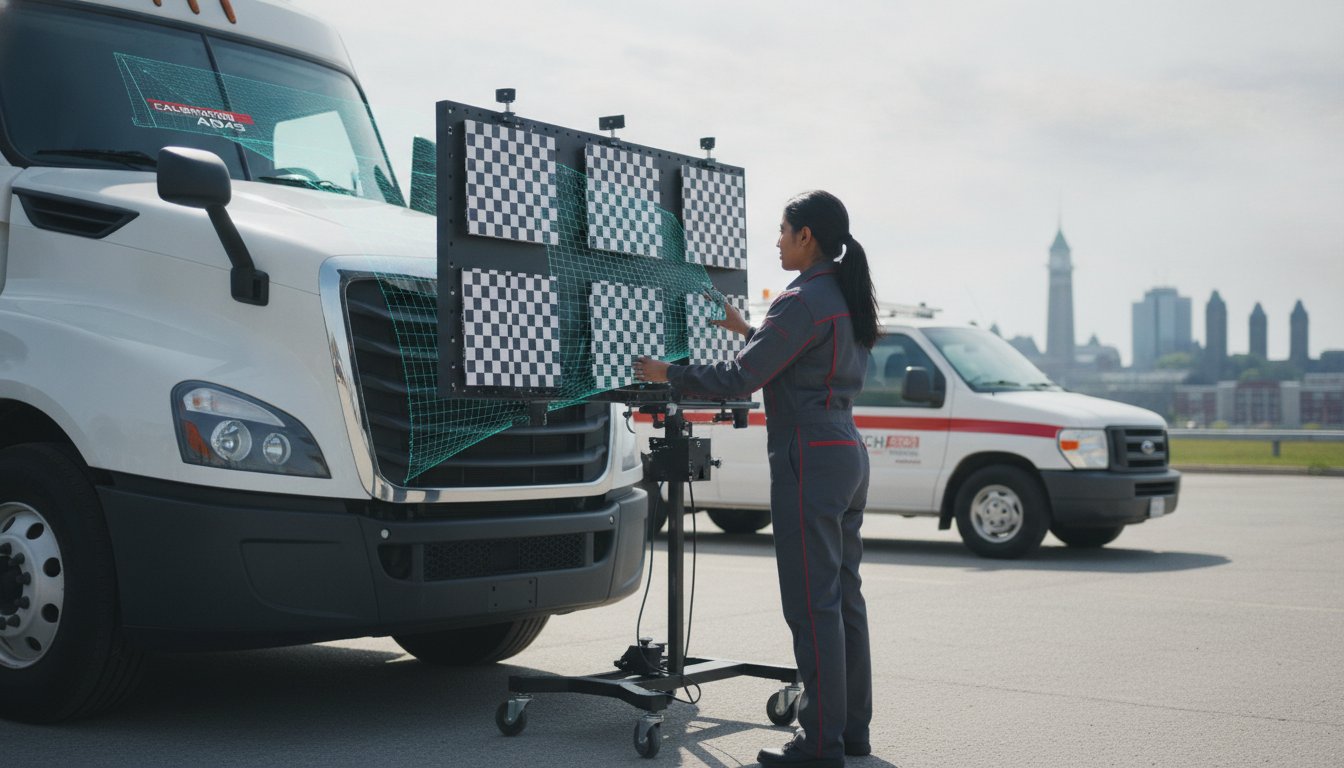
Recalibrating a heavy-duty truck or work van requires a more rigorous approach than a standard passenger vehicle. The process for commercial vehicle ADAS calibration Ottawa fleets undergo usually falls into two specific categories: static and dynamic. Static calibration occurs in a controlled service bay where technicians use specialized targets and laser levels to align the camera’s focal point. This method requires a perfectly level floor and precise lighting to ensure the sensors are reading the environment correctly. If the environment is not perfectly stable, the sensors may capture distorted data that leads to system failures on the road.
Dynamic calibration is a road-based procedure. The vehicle’s computer is placed into a “learning mode” while a technician drives it at specific speeds on roads with clear lane markings and identifiable landmarks. Many modern commercial vehicles actually require a dual-calibration, meaning they must pass both the static and dynamic stages to be fully certified. Commercial-grade Electronic Control Units (ECUs) are far more complex than those in consumer cars; they require specialized software to communicate with the vehicle’s internal safety network. This software allows us to clear fault codes and reset the “zero point” for the sensors, ensuring the system doesn’t rely on outdated data from before the repair.
Preparing Your Commercial Vehicle for Calibration
Successful calibration starts before the technician even plugs in their tools. If your truck is leaning because of low tire pressure or an empty fuel tank, the sensor’s angle will be fundamentally incorrect. We ask fleet owners to ensure a full tank of fuel and that all tires are inflated to the manufacturer’s specifications. It is also vital to remove heavy cargo or specialized equipment to simulate the vehicle’s standard operating weight. If the vehicle is weighed down on one side, the sensors will be misaligned once that load is removed. Correcting the vehicle’s physical alignment is a prerequisite for a successful sensor reset, as the computer needs a perfectly level baseline to function.
The Role of Certified Technicians
Precision is the only standard that matters. Measuring to the millimetre is the difference between a system that prevents a collision and one that fails during a crisis. General mechanics often lack the specific ADAS tooling required for commercial vehicle ADAS calibration Ottawa projects, especially for heavy-duty trucks with unique sensor heights. Our technicians are trained to handle the specific requirements of these sensors, ensuring every camera and radar unit is positioned exactly as the manufacturer intended. Once the process is complete, you receive a “Certificate of Calibration.” This document serves as your official proof of compliance for insurance files and safety audits, protecting your business from liability claims if an incident occurs later.
Schedule your ADAS Camera Recalibration today to ensure your fleet meets the highest safety standards and remains fully compliant with manufacturer specifications.
Reliable Fleet Glass & Calibration Services in the Ottawa-Gatineau Region
Managing a fleet in the National Capital Region is demanding enough without the added stress of coordinating technical sensor resets. At Auto Glass Ottawa, we specialize in minimizing your downtime by integrating our services directly into your existing workflow. We realize that every hour a van sits idle in a shop is an hour of lost revenue for your business. With over 15 years of experience serving the Ottawa and Gatineau commercial sectors, we’ve refined our process to be as frictionless as possible. Our technicians arrive with the specialized tools needed for commercial vehicle ADAS calibration Ottawa requirements, ensuring your safety systems return to OEM standards before your next scheduled delivery.
One of the biggest hurdles for fleet managers is the logistical headache of moving drivers back and forth to a service centre. We eliminate this friction with our 100% free mobile service. Whether your vehicles are parked at a warehouse in Kanata or an office in Orleans, we come to you. This on-site approach allows your team to focus on their primary tasks while we handle the technical precision of glass replacement and recalibration. To ensure long-term peace of mind, every project we complete is backed by a lifetime warranty on workmanship and leakage. It’s a professional partnership designed to keep your assets secure and your operations running smoothly.
Streamlining the Insurance Process
Administrative hurdles often cause more delays than the actual repair. Our team provides comprehensive Insurance Claim Assistance to take the burden off your desk. We have extensive expertise in handling complex fleet account paperwork and offer direct billing options to most major providers. By managing the communication with adjusters and deductibles, we get your drivers back on the road faster. This proactive approach ensures that your insurance records are always accurate and your coverage remains intact without you having to spend hours on the phone. We’re here to help you navigate the paperwork so you can focus on your bottom line.
Schedule Your Commercial Calibration Today
If you have an urgent need, we offer same-day service options for many commercial glass and calibration tasks. Our coverage extends across the entire region, including Kanata, Orleans, and Gatineau. Don’t let a small chip or a misaligned sensor turn into a major liability for your company. Book your commercial ADAS calibration with Auto Glass Ottawa and experience the reliability of a local team that values your time as much as your safety. We are ready to help you organize your fleet maintenance with the precision and speed your business requires for commercial vehicle ADAS calibration Ottawa projects.
Secure Your Fleet’s Future on Ottawa Roads
Maintaining your fleet’s safety technology is a continuous commitment to driver protection and business stability. You now understand that ignoring sensor alignment creates a significant liability risk, even if your dashboard remains free of warning lights. By prioritizing professional commercial vehicle ADAS calibration Ottawa services, you protect your company from denied insurance claims and ensure your vehicles meet strict safety standards. Precision is not just a technical requirement; it is a vital shield for your brand’s reputation and your drivers’ well-being.
Our certified technicians bring over 15 years of experience directly to your warehouse or office with our 100% free mobile service across Ottawa and Gatineau. We stand behind every calibration with a lifetime warranty on workmanship, giving you the peace of mind you deserve. Don’t let technical confusion or scheduling hurdles compromise your fleet’s productivity. You have the tools to keep your team safe and your operations running smoothly. Get a Free Mobile Quote for Your Fleet Calibration today and experience the reliability of a local partner who values your time. We look forward to helping you keep your fleet secure and your business moving forward.
Frequently Asked Questions
How long does a commercial ADAS calibration typically take?
Most commercial ADAS calibrations take between 60 and 90 minutes to complete. The exact time depends on your vehicle’s specific requirements and whether it needs static or dynamic procedures. We prioritize efficiency to ensure your driver is back on the road as quickly as possible without sacrificing the precision your safety systems require.
Does my insurance cover the cost of ADAS calibration in Ontario?
Yes, calibration is typically covered under the glass portion of your commercial insurance policy in Ontario. Since it is a required safety procedure following a windshield replacement, insurers treat it as a necessary part of the repair. We assist with the insurance paperwork to simplify the process and ensure your fleet remains compliant with manufacturer standards.
Can I drive my delivery van before the ADAS is calibrated?
We recommend against driving your vehicle for commercial duties until the sensors are properly reset. Operating a van with misaligned safety tech is a liability risk that could lead to “phantom braking” or a failure to detect genuine road hazards. It is safer to wait the short time required for calibration than to risk a preventable collision on a busy delivery route.
What happens if I ignore the ADAS calibration after a windshield replacement?
Ignoring calibration can lead to dangerous system malfunctions and potential legal negligence for your business. If an accident occurs, your insurance provider might deny the claim because the vehicle was not maintained to OEM safety standards. You also risk failing provincial safety inspections, which can lead to even more vehicle downtime and administrative hurdles.
Do all commercial vehicles have ADAS systems?
While not every older truck has these features, almost all new commercial vehicles manufactured after 2018 include some form of ADAS. If your van has lane departure warnings, adaptive cruise control, or collision avoidance, it requires specialized technical care. You can usually identify the camera housing by looking at the glass behind your rearview mirror.
Is mobile ADAS calibration as accurate as in-shop service?
Mobile calibration is just as accurate as in-shop service when performed by certified experts using the correct equipment. Our commercial vehicle ADAS calibration Ottawa mobile team uses precision software and specialized targets to meet manufacturer specifications on-site at your location. We always ensure the environment is level and stable before beginning any technical sensor reset.
How do I know if my fleet vehicle needs static or dynamic calibration?
Your vehicle’s manufacturer determines the required method based on the specific model and year. Some heavy-duty trucks require a static setup with physical targets in a controlled bay, while others need a dynamic road test. Our technicians scan your vehicle’s internal computer to identify the exact protocol needed for a successful and certified reset.
Will a small stone chip repair require me to recalibrate my camera?
A stone chip repair only requires recalibration if the damage or the repair itself is located within the camera’s critical field of vision. If the repair resin distorts the camera’s “view” of the road, the system may not function reliably. We inspect the location of every chip before the repair to determine if a full recalibration is necessary for driver safety.