
OEM or Aftermarket Windshield: Is the Extra Cost Worth It

The most expensive option isn’t automatically the best fit. Whether an OEM windshield is worth the cost depends on your vehicle’s features, the glass required for a precise fit and what your insurance covers. OEE glass is designed to meet the same safety and performance standards as OEM glass, and replacement windshields sold in Canada must meet Canada Motor Vehicle Safety Standard 205.
Whether an OEM windshield is worth the cost depends on your vehicle’s equipment, lease terms and insurance coverage. OEM glass may make sense when your vehicle has a windshield camera, head-up display or another feature that needs a precise match. For other vehicles, suitable OEE glass may meet the vehicle’s requirements.
This guide explains how OEM, OEE and aftermarket windshields differ, what to consider for fit and safety, and how insurance can affect your choice. It also covers ADAS recalibration after windshield replacement, so you can assess which option suits your vehicle.
Key Takeaways
- Match the glass choice to your vehicle’s features, especially cameras, a head-up display or acoustic glass.
- Understand how OEM, OEE and aftermarket glass differ in manufacturer, fit and compatibility before choosing.
- Review your insurance coverage and any lease requirements to see whether OEM glass is included.
- Account for ADAS recalibration in your decision, since sensor alignment can be part of a safe replacement.
Is aftermarket windshield glass safe?
OEM glass is the stronger choice when your vehicle’s camera, head-up display or other features need a precise match. In Canada, replacement windshields must meet Canada Motor Vehicle Safety Standard 205. That standard sets a safety baseline, but the glass must also suit the vehicle’s design and equipment.
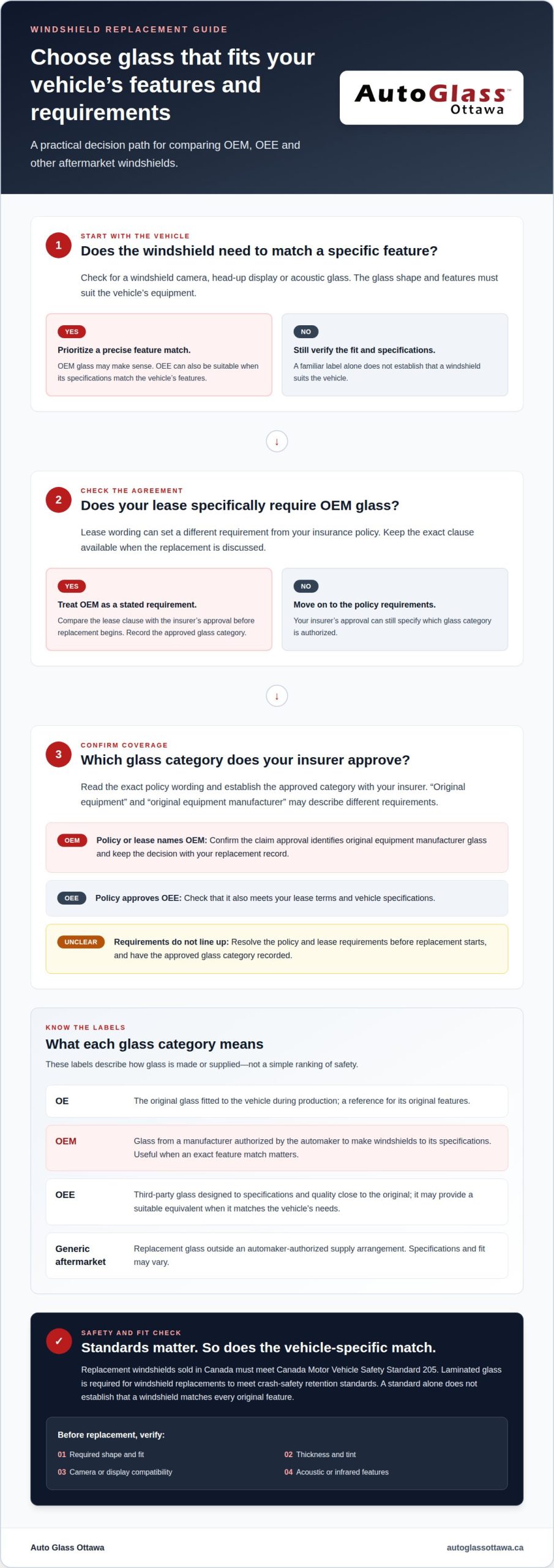
OE, OEM, OEE and Aftermarket Glass
OE means the original glass fitted to a vehicle during production. OEM glass comes from a manufacturer authorized by the automaker to make windshields to its specifications. OEE is made by a third party to specifications and quality close to the original. Aftermarket is a broader category for replacement glass made outside an automaker-authorized supply arrangement. These labels describe manufacturing relationships, not a simple ranking of safety.
OEM-Equivalent and Generic Aftermarket Glass
OEM-equivalent glass is designed to closely match original specifications, while generic aftermarket glass may not. Some manufacturers supply automakers with OEM glass, then sell the same glass under their own name as OEE. For a vehicle with a camera, head-up display or acoustic glass, the match to those features matters. Differences in fit or shape can affect compatibility.
OEM and Aftermarket Quality and Safety
OEM and OEE windshields are designed for vehicle requirements, but labels alone don’t establish fit or quality. Replacement windshields sold in Canada must meet Standard 205, and laminated glass is required for windshield replacements to meet crash-safety retention standards. Generic aftermarket glass may differ from OEM specifications, so consider the vehicle’s equipment as well as the glass category.
| Option | Maker or specification | Consideration |
|---|---|---|
| OE | Original factory-fitted glass | Reference for the vehicle’s original features |
| OEM | Authorized manufacturer, automaker specifications | Useful when exact feature matching matters |
| OEE | Third-party glass designed close to original specifications | Can provide a suitable equivalent |
| Generic aftermarket | Replacement glass outside automaker authorization | Specifications and fit may vary |
Choose OEM when your vehicle’s features or lease terms call for an exact match. OEE may suit your vehicle when its specifications meet the needs of its equipment. Insurance coverage can also specify which glass category is authorized, so include that requirement in your decision.
Insurance coverage for OEM windshields
Insurance approval and lease wording can determine which glass category is authorized for your replacement. In Ontario, most comprehensive insurance policies generally cover OEM-equivalent glass by default. True OEM glass is covered when the policy or lease specifically requires it. Read the exact wording, since “original equipment” and “original equipment manufacturer” can describe different requirements.
A lease can set a different standard from your insurance policy. Some vehicle lease agreements specify OEM parts, including windshields. If your lease specifies OEM glass but your insurer approves OEE, both documents still matter. Keep the lease clause available when discussing the claim so the insurer can account for the vehicle’s contractual requirements.
To keep the claim clear, report the damage to your insurer and establish which glass category your policy authorizes. Compare that approval with your lease terms and any policy endorsement naming OEM glass. Before replacement begins, have the approved category recorded in the claim or repair documentation. This gives you a clear reference if questions arise about whether the installed windshield met the stated requirements.
- Policy names OEM: Confirm that the claim approval identifies original equipment manufacturer glass.
- Policy specifies OEE: Check whether that category meets any separate lease condition.
- Lease names OEM: Keep its part requirement in view during claim handling.
Ontario and federal consumer protection rules generally prevent automakers from voiding a vehicle warranty solely because a non-OEM part was used, provided the part meets the required specification. This warranty protection does not change a lease clause or determine what an insurance policy covers. Keep the insurer’s decision, lease wording and replacement record together for future reference.
Aftermarket and OEE windshield differences
“Aftermarket” covers replacement glass made outside an automaker’s authorized OEM supply arrangement. OEE means original equipment equivalent: glass made to specifications and quality close to the original. These labels describe different manufacturing relationships, but neither alone tells you how well a windshield will suit your vehicle.
Some suppliers make both OEM and OEE glass. A manufacturer may supply a windshield to an automaker, then sell the same glass under its own name without the automaker’s logo. Other aftermarket glass makers aren’t licensed by car companies to produce OEM glass. This explains why windshields from the same manufacturer can carry different labels.
Fit and features matter when replacing a windshield. OEE glass may have slight variations from the original, which can affect how precisely it fits. Compare the required shape, thickness, tint and any acoustic or infrared features with the glass being considered. A vehicle with a windshield camera or head-up display needs a suitable match for those systems, not just a familiar brand name.
Both OEE and aftermarket glass must be assessed against applicable safety standards and your vehicle’s specifications. Meeting a safety standard does not by itself establish that a part matches every original feature. For example, a windshield may suit a vehicle without a camera but be a poor match for a trim with a camera or projected display.
| Glass type | How it is made or sold | Key consideration |
|---|---|---|
| OEM | Made by an automaker-authorized supplier to its specifications | Original-brand specification and features |
| OEE | Third-party glass designed close to original specifications | Equivalent features and fit for the vehicle |
| Aftermarket | Replacement glass outside the automaker’s OEM arrangement | Specifications and fit can vary |
For a vehicle without specialized glass or sensors, a suitable OEE windshield may meet your needs. If exact original features matter, prioritize a proven match. Weigh the supplier, vehicle fit, required features and budget together.
OEM versus OEE windshield costs
Compare replacement options by matching the glass to your vehicle’s exact configuration, not by choosing a label alone. A model’s trim, built-in features and windshield shape can affect which part is appropriate. Ask for the selected glass category and specifications to be recorded clearly, so you understand what the replacement includes.
Availability can also shape the decision. OEM windshield stock may be limited for older vehicles and some newer models. If the exact part is unavailable, an equivalent option may be considered, provided it suits the vehicle’s requirements. The key question is whether the glass matches the required configuration, not whether one category is always preferable.
For vehicles with advanced equipment, include installation steps in your assessment. A windshield camera needs recalibration after replacement, so the plan should account for that work. Clarify how the technician will confirm the camera’s alignment and whether the glass has the features required for your vehicle’s trim.
Use this checklist to assess the replacement plan:
- Confirm the glass category and vehicle-specific specifications.
- Make sure the selected part suits the vehicle’s trim and installed features.
- Account for camera calibration when the vehicle’s equipment requires it.
- Consider whether OEM availability affects the suitable replacement options.
OEM is a strong fit when the exact automaker specification is needed and available. OEE can be appropriate when its specifications suit the vehicle and its equipment. For help reviewing a windshield replacement plan, contact our team.
Auto Glass Ottawa
Auto Glass Ottawa helps you choose a practical next step when windshield damage leaves you weighing OEM and equivalent glass. We provide windshield repair and replacement, along with insurance claim assistance, so you can consider the glass type, vehicle features and coverage together. If a replacement is needed, our technicians can account for whether your vehicle’s camera requires recalibration.
For drivers in Ottawa and Gatineau, mobile service brings repair or replacement to your home or workplace, reducing disruption to your day. Share your vehicle details and insurance information so the replacement options can be considered in context. Then you can make an informed decision focused on fit, safety and your policy requirements.
Contact Auto Glass Ottawa to discuss your windshield damage and the options for your vehicle.
Make your next step a confident one
Whether an OEM windshield is worth the cost depends on what matters most for your vehicle: a precise match, your lease or insurance terms, or a straightforward replacement. Before moving ahead, consider how long you plan to keep the vehicle and whether its equipment depends on specific glass features. These priorities can help you choose an option that suits your safety needs and ownership plans.
You don’t need to make the decision based on a label alone. A clear discussion of your vehicle and its damage can help connect the glass choice with the work required. If you’re still weighing the options, contact Auto Glass Ottawa for advice and talk through a practical next step.
With the right information, you can move forward with greater confidence and less uncertainty.
Frequently Asked Questions
Is OEM Windshield Better?
Not in every situation. The better choice depends on your vehicle’s exact configuration. Two trims of the same model, for example, may have different windshield features, so a glass option that suits one may not suit the other. OEM can be a sensible choice when the automaker’s specified part is needed. For other configurations, a suitable equivalent may meet the vehicle’s requirements.
Does the glass type affect ADAS calibration?
Yes. The replacement glass must suit the vehicle’s camera system, and calibration checks that the camera is aligned after installation. A camera behind the rear-view mirror, for example, may need recalibration when its windshield is replaced. Ask whether calibration is included in the replacement plan, and confirm the work follows the vehicle manufacturer’s requirements. Correct glass selection and sensor alignment both matter.
Can I request true OEM glass instead of OEM-equivalent?
Yes, you can request true OEM glass, but your insurer’s approval and lease terms can affect the choice. If your policy authorizes equivalent glass, requesting OEM may leave a difference for you to pay. State your preference before replacement is approved, and have the approved glass category recorded. This gives you a clear reference if your insurer and lease specify different requirements.
Does going aftermarket void your warranty?
Using non-OEM glass does not, by itself, void a vehicle warranty in Ontario, provided the replacement part meets the required specifications. That protection concerns the automaker’s warranty; it does not change the terms of a separate lease or insurance policy. Keep the replacement paperwork, including the glass description, so you can show what was installed if a warranty question arises.
How do I find out which glass I am getting?
Ask for the glass category and manufacturer to be identified on the estimate or invoice. “OEM-quality” does not necessarily mean automaker-branded OEM glass, so clarify whether the part is OEM, OEE or other aftermarket glass. At Auto Glass Ottawa, OEM-quality glass is standard, and aftermarket glass is available if you request it. Match the written description to your insurer’s approval.
OEE vs OEM Glass: What’s the Real Difference?
OEM glass is made by a supplier authorized by the automaker to its specifications; OEE is made to specifications and quality close to the original. The practical distinction is authorization and branding, not simply whether a part is safe or suitable. For a vehicle with a less common trim or special glass feature, focus on whether the specific part matches that configuration.